Tool · sources checked 2026-11-02Knife hardness chart:
what HRC really means
Quick answer: HRC is hardness on the Rockwell C scale: a 120° diamond cone is pressed into the steel at 150 kgf, and every point on the scale means the permanent dent is 2 µm (0.002 mm) shallower. Japanese knife steelmakers rate their steels from 58 HRC or more (SLD) to 65 or more (ZDP-189), with HAP40 at 64–68; a German Zwilling Four Star is 57 HRC. Going from 58 to 60 HRC makes the dent 4 µm shallower and, in Knife Steel Nerds’ edge-retention model, adds about 32 mm of card cut for the same steel and angle — a longer-lasting edge that is a little less tough.
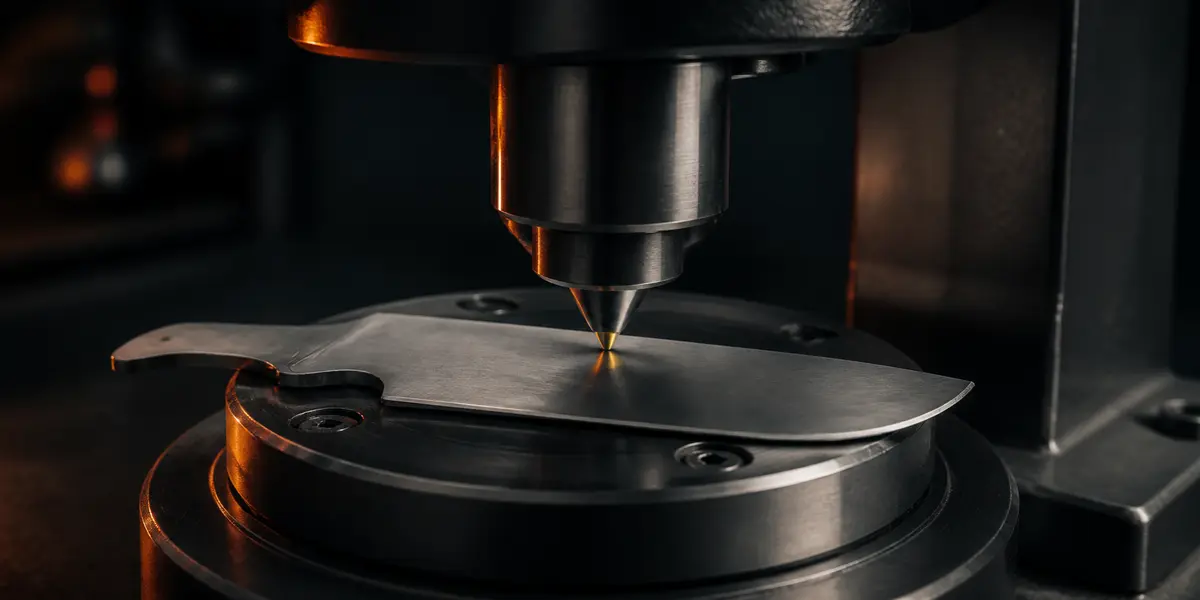
 Slide the hardness: the dent, the edge and the stone
Move the slider from 50 to 70 HRC. The cross-section is the real geometry of a Rockwell C test, drawn to scale: the diamond cone has a blunt 0.2 mm tip, and the number you read is only the extra depth h below the zero line. The three panels underneath show what that hardness tends to mean for a kitchen edge.
Drawn to scale (the bar is 100 µm = 0.1 mm). Dashed line: zero, set under the 10 kgf preload. h: the depth left below zero after the 150 kgf load is removed. Top right: the whole 120° cone; the box marks the tip that fills the main drawing.
- Permanent depth h
- 80 µm (0.080 mm)
- HRC = 100 − h ÷ 2 µm
- 100 − 80 ÷ 2 = 60
- Card cut vs the same steel at 60 HRC
- ±0 mm (Knife Steel Nerds model)
Press “Run” to see the three steps of the test.
The edge after a twist
In between. Harder resists rolling, softer resists chipping, and the change is gradual. Where a real knife sits also depends on its steel, edge angle and what it cuts.
On the whetstone
Harder steel resists wear, and wear resistance is what you grind against.
Card cut in a CATRA test
Each strip = 1 HRC ≈ 15.8 mm of card for the same steel at the same edge angle.
 How the Rockwell C test works
Rockwell testing is defined in ASTM E18, ISO 6508 and JIS Z 2245, which Struers, a maker of hardness testers, describes as aligned in their core principles. The C scale is the one for hardened steel. A softer steel lets the cone sink deeper, so it gets a lower number; readings below about 20 HRC are generally considered unreliable on this scale.
- 1Preload 10 kgf (98 N)
The 120° cone seats on the steel and the depth gauge is set to zero.
- 2Total load 150 kgf (1,471 N)
Another 140 kgf drives the cone deeper into the steel.
- 3Back to 10 kgf: read h
The elastic part springs back. The depth left below zero gives HRC = 100 − h ÷ 0.002 mm.
 Knife hardness chart: Japanese steels by maker hardness
Every steel on this site, placed by the hardness its maker publishes after standard hardening. Next to it are two numbers that are often confused with it: the hardness Knife Steel Nerds measured on its edge-retention test blades, and the hardness a knife brand states for a finished knife. Look at Aogami Super: Proterial’s minimum is 60, but the test blade was hardened to 65.1. And SG2’s test blade measured 61.2, below Takefu’s ≥62 rating — the finished hardness is set by whoever heat-treats the blade.
- 68Maker↕ HAP40 66–68 range
- 67Maker↕ HAP40 66–68 range
- 66
- 65
- 64MakerHAP40 64–66
- 63
- 62MakerSG2 ≥62
- 61MakerVG-1 ≥61
- 60MakerShirogami #1 ≥60Shirogami #2 ≥60Shirogami #3 ≥60Aogami #1 ≥60Aogami #2 ≥60Aogami Super ≥60VG-10 ≥60AUS-10 60 ref.Test bladeSLD (as D2) 60.5
- 59
- 58MakerSLD ≥58Knife↕ Zwilling Four Star 55–58 range
- 57KnifeZwilling Four Star 57 (spec 55–58)
- 56Knife↕ Zwilling Four Star 55–58 range
- 55Knife↕ Zwilling Four Star 55–58 range
60 HRC — Maker: Shirogami #1 ≥60, Shirogami #2 ≥60, Shirogami #3 ≥60, Aogami #1 ≥60, Aogami #2 ≥60, Aogami Super ≥60, VG-10 ≥60, AUS-10 60 ref.; Test blade: SLD (as D2) 60.5.
| Steel | Type | Maker hardness (HRC) | Test blade HRC · CATRA | Head-to-head |
|---|---|---|---|---|
| HAP40HAP40 | Powder high-speed · not stainless | 64–66 or 66–68 (by quench temperature) | not tested | HAP40 vs SG2 |
| ZDP-189ZDP189 | Powder stainless | ≥65 | 65.1 · 718 mm | — |
| SG2スーパーゴールド2 | Powder stainless | ≥62 | 61.2 · 522 mm | Aogami Super vs SG2 · VG-10 vs SG2 · HAP40 vs SG2 |
| VG-1V金1号 | Stainless | ≥61 | not tested | — |
| Aogami #1青紙1号 | Carbon · not stainless | ≥60 | not tested | Blue vs White steel · Blue #1 vs Blue #2 |
| Aogami #2青紙2号 | Carbon · not stainless | ≥60 | not tested | Blue vs White steel · Blue #1 vs Blue #2 · Aogami Super vs Blue #2 |
| Aogami Super青紙スーパー | Carbon · not stainless | ≥60 | 65.1 · 338 mm | Blue vs White steel · Aogami Super vs SG2 · Aogami Super vs Blue #2 |
| AUS-10AUS-10 | Stainless | 60 (reference value) | not tested | VG-10 vs AUS-10 |
| Shirogami #1白紙1号 | Carbon · not stainless | ≥60 | not tested | Blue vs White steel · White #1 vs White #2 |
| Shirogami #2白紙2号 | Carbon · not stainless | ≥60 | not tested | Blue vs White steel · White #1 vs White #2 |
| Shirogami #3白紙3号 | Carbon · not stainless | ≥60 water-quenched | not tested | Blue vs White steel |
| VG-10V金10号 | Stainless | ≥60 | 61.6 · 479 mm | VG-10 vs SG2 · VG-10 vs AUS-10 · Ginsan vs VG-10 · SLD vs VG-10 |
| AUS-8AUS-8 | Stainless | 59 (reference value) | not tested | — |
| Ginsan銀紙3号 | Stainless | ≥59 | not tested | Ginsan vs VG-10 |
| SLDSLD | Semi-stainless | ≥58 | 60.5 · 486 mm (as D2) | SLD vs VG-10 |
Maker hardness: the hardening hardness each steelmaker publishes (Proterial, Takefu Special Steel; AUS-8 and AUS-10 are reference values from Aichi Steel’s group company). HAP40’s two ranges come from two quench temperatures on Proterial’s sheet. Test blade: hardness Knife Steel Nerds measured on its CATRA test blades (15° per side, 400-grit CBN finish), with the total card cut. For composition and sources, open each steel’s page or the full Japanese knife steel chart.
Who sets the hardness: the steelmaker or the smith?
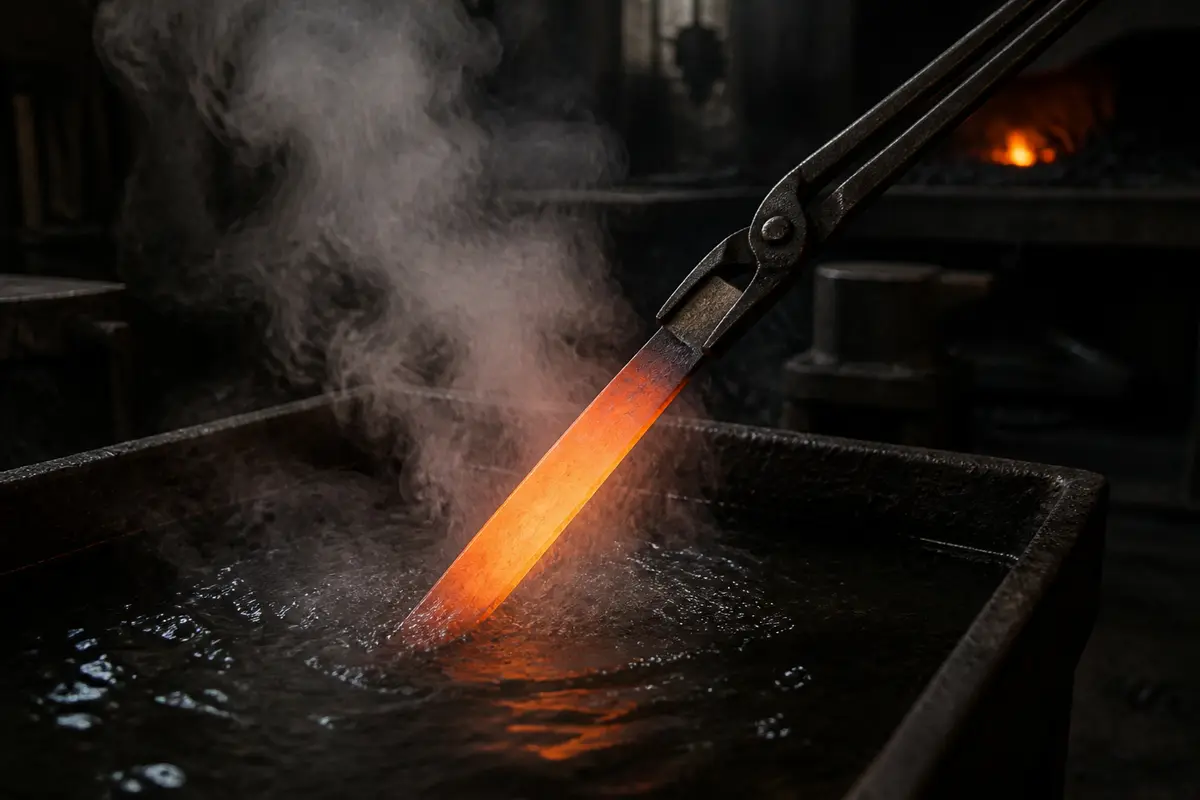
A steelmaker’s figure tells you what the steel reaches under its own standard heat treatment. The finished hardness is decided by whoever hardens the blade — in Sakai, a separate trade from sharpening and handle fitting (see the history of Sakai knives). Proterial’s standard treatments show how differently these steels are handled: the paper steels are quenched from about 800 °C in water, the stainless and die steels from 1,000 °C or more, and the high-speed steel HAP40 from about 1,200 °C.
| Steel | Quench from | Temper at | Hardness | Maker |
|---|---|---|---|---|
| Shirogami #1, #2 | 760–800 °C, water | 180–220 °C | ≥60 | Proterial |
| Aogami #2, Aogami Super | 780–830 °C, water (or oil) | 160–230 °C | ≥60 | Proterial |
| Ginsan (Silver #3) | 1,000–1,050 °C, air (or oil) | 100–150 °C | ≥59 | Proterial |
| SLD (≈ D2 / SKD11) | 1,030 °C, air | 180 °C or 500 °C | ≥58 | Proterial |
| HAP40 | 1,180–1,210 °C, oil / 1,120–1,190 °C | 560–580 °C | 66–68 / 64–66 | Proterial |
| VG-10 | not published on the maker’s page | high-temperature tempering gives secondary hardening | ≥60 | Takefu |
Two lessons sit in that table. First, the same steel can finish several points apart: Proterial’s HAP40 sheet gives 64–66 or 66–68 HRC depending only on the quench temperature. Second, a published “≥60” is a floor, not a promise about your knife. When a shop gives the HRC of the knife itself, that is the number to compare; the steel’s rating only tells you the range it was designed for. How a blade is built — one piece of steel, or a hard core clad in softer steel — is explained in honyaki vs kasumi vs san-mai.
58 vs 60 HRC — and 62, 65: what a few points change
The Rockwell number is linear in depth by definition, so 58 → 60 HRC is a dent 84 → 80 µm deep. How much that matters in the kitchen comes from tests, not from the scale. Knife Steel Nerds fitted a regression to CATRA data supplied by a knife company (steels from 46 to 69 HRC, edge angles from 20° to 61°) and found about 15.8 mm more card per HRC point for the same steel and angle. Two points is about 31.6 mm — roughly 7% of the 479 mm a VG-10 blade cut in Knife Steel Nerds’ own CATRA test. In another study the same author found that hardness has less effect than the edge angle: total card cut ran from over 1,000 mm with a 20° inclusive edge (10° per side) to under 100 mm at 56° inclusive.
| HRC | Permanent depth h | Card cut vs 60 HRC, same steel (model) | What sits here |
|---|---|---|---|
| 56 | 88 µm | −63.2 mm | — |
| 57 | 86 µm | −47.4 mm | Knife: Zwilling Four Star 57 |
| 58 | 84 µm | −31.6 mm | Maker: SLD |
| 59 | 82 µm | −15.8 mm | Maker: Ginsan, AUS-8 |
| 60 | 80 µm | ±0 mm | Maker: Shirogami #1, Shirogami #2, Shirogami #3, Aogami #1, Aogami #2, Aogami Super, VG-10, AUS-10 · Test blade: SLD (as D2) 60.5 |
| 61 | 78 µm | +15.8 mm | Maker: VG-1 · Test blade: VG-10 61.6, SG2 61.2 |
| 62 | 76 µm | +31.6 mm | Maker: SG2 |
| 63 | 74 µm | +47.4 mm | — |
| 64 | 72 µm | +63.2 mm | Maker: HAP40 (lower quench, 64–66) |
| 65 | 70 µm | +79.0 mm | Maker: ZDP-189 · Test blade: Aogami Super 65.1, ZDP-189 65.1 |
| 66 | 68 µm | +94.8 mm | Maker: HAP40 (higher quench, 66–68) |
Card cut: the hardness coefficient (15.8 mm per Rc) of Knife Steel Nerds’ regression of a knife company’s CATRA data, holding steel and edge angle constant. It is a model fitted to lab data, not a measurement of any one knife. Rows are whole HRC points (a test blade at 61.6 sits in the 61 row). “Maker” is the steelmaker’s hardening hardness; “Test blade” is Knife Steel Nerds’ measured hardness; “Knife” is a finished knife’s published hardness.
Is 58 HRC good? For a tough, easy-to-hone everyday knife, yes — Zwilling’s Four Star sits at 57. 58 is also the lowest Japanese steelmaker rating on this site (SLD, ≥58). How hard is 60 HRC? It is the floor Takefu publishes for VG-10 and Proterial for the White and Blue paper steels. For the trade-off in practice, compare VG-10 vs AUS-10 or HAP40 vs SG2.
 Harder vs tougher: rolling, chipping and the edge angle
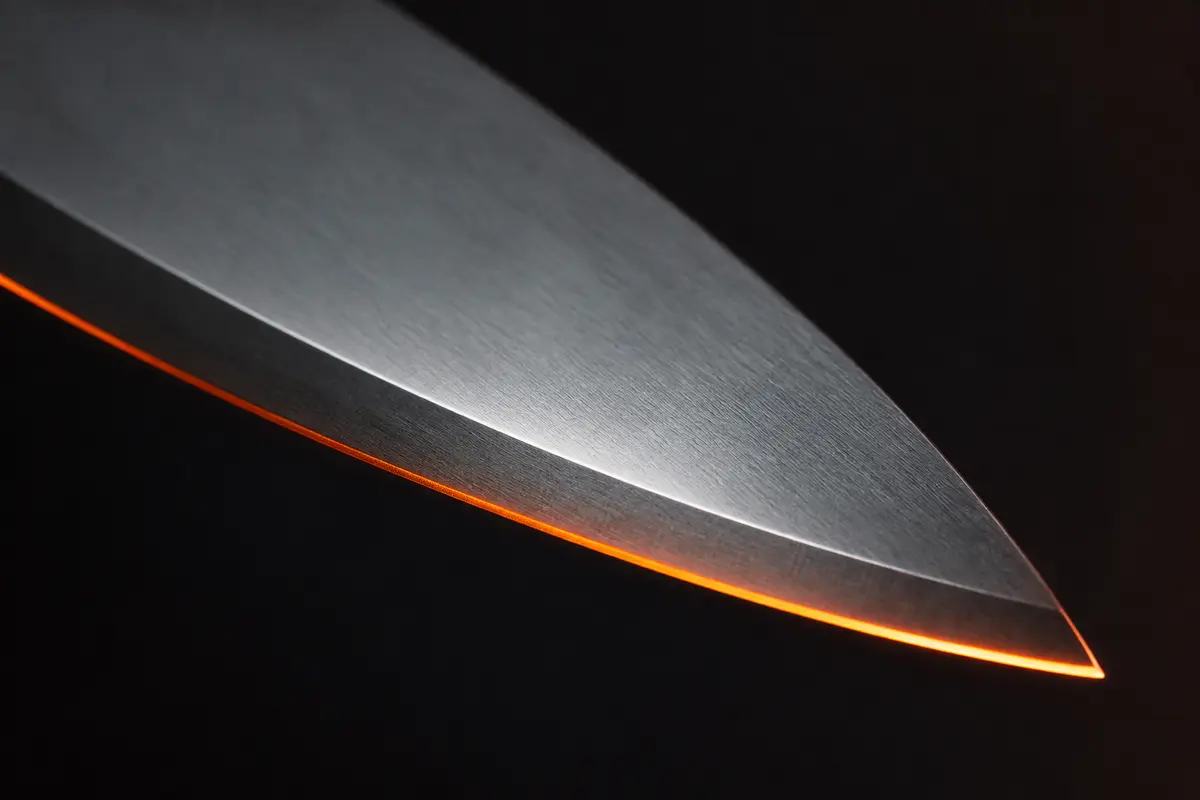
Knife Steel Nerds explains the two ways an edge fails. Higher hardness usually means a higher yield stress, so a thin edge resists being bent over — rolling. But higher hardness also lowers toughness, and resistance to chipping is broadly controlled by toughness. Larger carbides and more carbide make chipping more likely as well. So the harder the steel, the better a fine edge resists bending — and the more likely it is to chip when it is twisted, levered or driven into something hard.
The direction is clear even though no source gives a hardness where one failure takes over from the other: the softer the edge (a German-style knife around 57 HRC, say), the more it tends to roll; the harder, the more the risk shifts toward chipping. That is why hard Japanese knives are kept away from bones, frozen food and twisting cuts. See both edges magnified in Japanese vs German knives, and what to do when it happens in the chipped knife repair guide. The edge angle is the other lever — in Knife Steel Nerds’ edge-angle study it had more effect on edge retention than hardness; the sharpening angle calculator turns any angle into a spine height on the stone.
 Is harder steel harder to sharpen?
For the same steel, yes. Knife Steel Nerds notes that harder steels resist wear better and that ease of sharpening is the inverse of wear resistance. Between different steels the carbides count as well — its edge-retention model weighs carbide volume and type alongside hardness. The makers’ own words point the same way: Takefu describes VG-10 (≥60 HRC) as easy to sharpen, while Proterial gives HAP40 its top “A” rating for wear resistance. How long a session takes also depends on the stone; the whetstone grit chart shows what each grit does.
 How to choose a hardness for your kitchen
- 1Ask whose number it is
“≥60 HRC” next to a steel name is usually the steelmaker’s minimum. If the hardness matters to you, ask the shop for the knife’s own HRC.
 2Vegetables, fish, boneless meat
Harder steel helps a thin edge resist rolling, which suits push-cutting food that has no bones or ice in it.
- 3Bones, frozen food, twisting
Here harder is not better: higher hardness lowers toughness, so a hard, thin edge is more likely to chip. Use a thicker, tougher knife.
- 4Plan the sharpening
Harder and more wear-resistant steels take more work on the stone — Knife Steel Nerds calls ease of sharpening the inverse of wear resistance.
If you are choosing between two steels rather than two hardness numbers, the head-to-heads put the makers’ data side by side: VG-10 vs AUS-10, Ginsan vs VG-10, SLD vs VG-10, Aogami Super vs Blue #2, HAP40 vs SG2 and VG-10 vs SG2. Every comparison is listed on the comparisons page.
Frequently asked questions
- What does HRC mean on a knife?
- HRC is hardness on the Rockwell C scale. A diamond cone with a 120° point is pressed into the steel under a 10 kgf preload and then a 150 kgf total load, and the hardness is read from the depth that remains: HRC = 100 − depth ÷ 0.002 mm. Each point is a dent 2 µm shallower. On a knife listing it is usually either the steelmaker’s hardening hardness (often a minimum such as “≥60”) or the hardness the knifemaker measured on the finished blade.
- Is 58 HRC good for a kitchen knife?
- Yes, for a tough, easy-to-hone knife. Zwilling lists its Four Star chef’s knife at 57 HRC (55–58 in its specification). It is softer than most Japanese steels — steelmakers rate VG-10, Shirogami and Aogami at 60 HRC or more — so its edge leans toward rolling rather than chipping, and it holds a thin edge for less time. Compared with 60 HRC, the Rockwell dent is 4 µm deeper and, in Knife Steel Nerds’ regression of CATRA data, the same steel at the same angle cuts about 31.6 mm less card.
- How hard is 60 HRC?
- At 60 HRC the cone leaves a permanent dent 80 µm (0.08 mm) below the zero line set by the preload. It is the minimum hardening hardness Takefu publishes for VG-10 and Proterial for its White and Blue paper steels, and three points above Zwilling’s Four Star (57 HRC).
- What is the highest Rockwell hardness for a kitchen knife?
- Of the steels on this site, Proterial gives HAP40 66–68 HRC after its higher quench temperature, and rates ZDP-189 at 65 HRC or over. Knife Steel Nerds measured 65.1 HRC on its Aogami Super and ZDP-189 test blades. Higher hardness lowers toughness, so knives this hard need to be kept away from bones, frozen food and twisting.
Sources
- Struers: Rockwell hardness testing (HR = E − e, e in units of 0.002 mm; ASTM E18, ISO 6508, JIS Z 2245)
- Buehler: Rockwell hardness testing (120° diamond cone; 10 kgf minor load; 2 µm of movement = 1 Rockwell point)
- Wikipedia: Rockwell hardness test (120° diamond cone, 0.2 mm tip radius, 10 kgf minor load, 150 kgf for the C scale)
- Knife Steel Nerds: which steel has the best edge retention? Part 1 (regression of a knife company’s CATRA data, 15.8 mm per Rc)
- Knife Steel Nerds: testing the edge retention of 48 knife steels (test conditions, measured hardness)
- Knife Steel Nerds: maximizing edge retention (inclusive edge angles of 20–56° vs hardness)
- Knife Steel Nerds: what is edge stability? (hardness, rolling and chipping)
- Knife Steel Nerds: chipping of edges (hardness, toughness, carbides)
- Knife Steel Nerds: is Blue Super actually super? (ease of sharpening and wear resistance)
- Proterial: Shirogami #1 (heat treatment, hardening hardness)
- Proterial: Aogami #2 (heat treatment, hardening hardness)
- Proterial: Aogami Super (heat treatment, hardening hardness)
- Proterial: GIN 3 / Ginsan (heat treatment, hardening hardness)
- Proterial: SLD (AISI D2 / JIS SKD11 equivalent; heat treatment)
- Proterial: HAP40 (hardness by quench temperature; property ratings)
- Takefu Special Steel: V Gold No.10 (VG-10)
- Aichi Techno Metal Fukaumi: AUS stainless steels (reference hardness after quenching and tempering)
- Zwilling: Four Star chef’s knife 8 inch (57 HRC; specification 55–58 HRC)
Checked 2026-11-02. We have not measured any knife ourselves; the dent depths follow from the definition of the scale, and the card-cut figures from Knife Steel Nerds’ published model. Few knife brands publish the hardness of a finished knife on their own pages, so the finished-knife column is short. Found a better source or an error? Tell us.