SakaiSakai, Osaka:
the knife town
In short: Sakai, in southern Osaka, is where SAKAI EDGE is written and one of Japan’s historic knife towns. Its knives are made by a chain of specialist workshops — a smith forges the blade, a sharpener grinds and finishes it, and a handle maker fits it — and the town is best known for single-bevel knives for professional chefs, such as the deba and yanagiba. Sakai forged blades became a national traditional craft in 1982.
Read more about Sakai
- History of Sakai knives — a timeline from the arrival of guns and tobacco in 1543, the tobacco knives sold under the shogunate’s “Sakai kiwame” seal and the Genroku-era deba, to the 1982 craft designation, the 2007 regional trademark and today’s craftsmen, with sources including National Diet Library books.
- Japanese knife towns compared — Sakai, Seki, Echizen/Takefu, Tsubame-Sanjo, Miki and Tosa side by side: craft system, typical steels and share of Japan’s kitchen-knife shipments.
How a Sakai knife is made
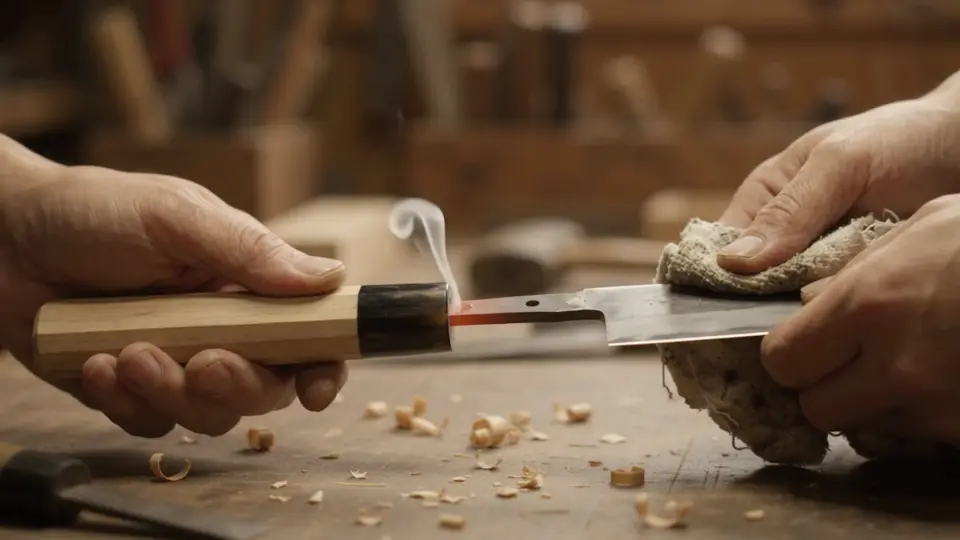
The defining feature of Sakai is the division of labour. A blacksmith (kajiya) forge-welds soft iron to hard carbon steel, hammers out the profile and heat-treats the blank; a separate sharpening workshop (togishi) grinds the bevel, the hollow back and the edge on large water-cooled wheels; a handle maker fits the wa handle; and a wholesaler (ton’ya) traditionally coordinates the work, stamps the brand and sells the knife. Each trade takes 10–15 years or more to master. A survey for a Ryukoku University thesis (2015–2017) counted 54 active workshops — 21 blacksmith and 33 sharpening workshops — and 97 craftsmen, many of them over 60 and few with apprentices.
That system grew from a long history. When guns and tobacco arrived from Portugal in 1543, Sakai’s smiths made guns and tobacco-cutting knives; around the Genroku era (1688–1704) they were making the deba and other single-bevel kitchen knives. The name “堺打刃物” (Sakai forged blades) has been a registered regional collective trademark since 5 October 2007.
Sakai among Japan’s knife towns
By shipment value, Japan’s kitchen knives come mostly from elsewhere: Seki in Gifu and Tsubame-Sanjo in Niigata together make over 80%, led by stainless and clad double-bevel knives, while Osaka (Sakai) accounts for roughly 7% (2020). Sakai’s weight is in hand-forged professional knives, especially single-bevel ones. Echizen in Fukui, Miki in Hyogo and Tosa in Kochi are other traditional forging towns, each with its own steels and grinding style.
Choosing and buying a Sakai knife
A single-bevel Sakai knife asks for a different sharpening technique and comes in left- and right-handed versions, so read single-bevel vs double-bevel before you choose one. Many are forged from Proterial’s carbon steels — compare Blue vs White steel — and need the care routine in Japanese knife care. Buying from the US or on a trip to Japan? Start from the buying guides.