Care & sharpening · sources checked 2026-11-02Honing rods and Japanese knives:
steel, ceramic or strop?
Short answer: it depends on the rod, the steel and whose advice you follow — and the advice really is split. Shun sells a steel honing rod with a 16° guide for its own Japanese knives, while Zwilling Japan says its chrome-plated steel cannot be used on knives of HRC 60 or more, Miyabi included. Specialist shops warn that a grooved steel can chip a hard Japanese edge and point to a fine ceramic rod. If you hone, use a smooth or fine ceramic rod at your sharpening angle (about 15–16°) with 3–5 feather-light strokes per side, keep single-bevel knives on flat stones (as Chef Knives To Go advises), and sharpen on a whetstone when that stops working.
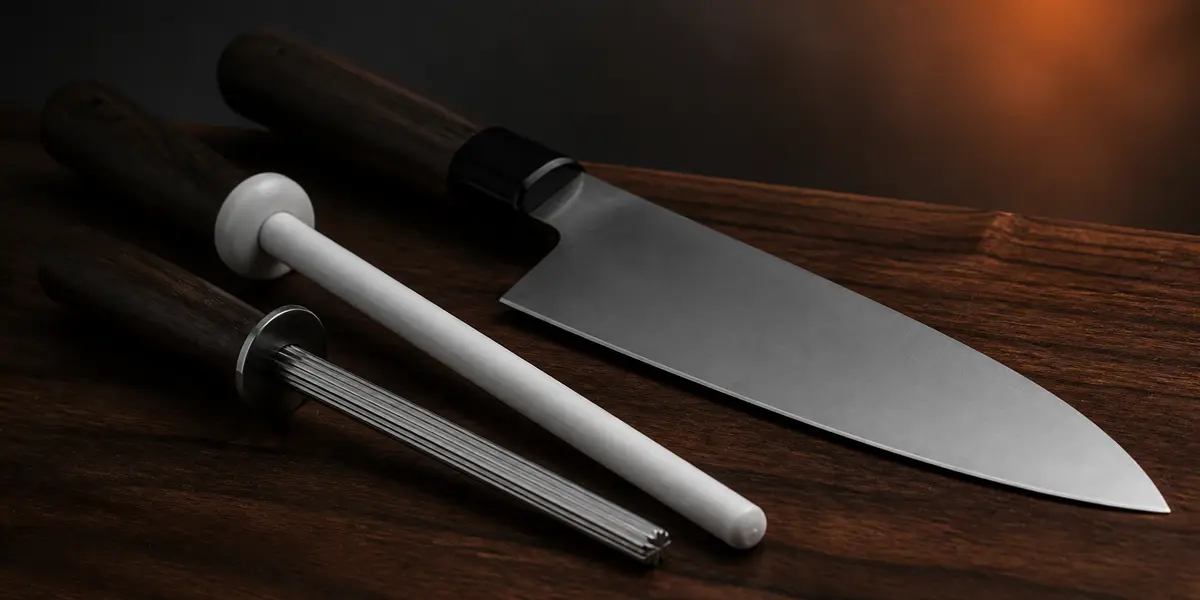
 Edge lab: what each rod does to the apex
Pick a tool, tell the lab whether your knife is a softer Western blade or a hard Japanese one, then change the rod angle and the number of strokes. The cross-section starts from a used edge whose apex has rolled over (dashed). The strip below shows the same edge from the side: white glints mean a rolled or dull edge, the orange band is the new micro-bevel, red notches are chips.
| Reaches the apex | Yes |
|---|---|
| Rolled edge | Removed / straightened |
| New micro-bevel | ≈ 17° per side (34° inclusive) |
| Steel removed | very little |
| Chips | None |
Illustration, not a micrograph. Angles are drawn true (15° per side edge); the sizes of the micro-bevel, scratches and chips are exaggerated so you can see them.
Tool
Your knife
Gentle touch-up. A fine ceramic rod takes off a tiny amount of steel and leaves a small micro-bevel at the apex. Science of Sharp saw black steel swarf on the white rod: it does remove metal, slowly.
What happens follows the sources on this page: every rod removed some metal and left a micro-bevel in Science of Sharp’s electron-microscope images; Verhoeven found two back-and-forth passes on a smooth steel better than fifteen; Chef Knives To Go and Chubo say grooved steel can chip 60+ HRC edges; America’s Test Kitchen found diamond rods too aggressive. The amounts are SAKAI EDGE’s illustration, not measurements.
 Who says you can — and who says you shouldn’t
Search “can you use a honing rod on a Japanese knife” and you get confident answers in both directions. Here is who says what, in their own published material:
Sell or top-rate steel rods
- Shun (Kai USA) Sells a stainless honing steel with a smooth face, a micro-ribbed face and a 16° angle guide for its Japanese knives, and says honing realigns the edge without removing metal. Source · Source
- Zwilling US Sells a Miyabi-branded stainless sharpening steel. Source
- America’s Test Kitchen Its top pick among nine rods was a steel with grooved and smooth faces — tested on a new Western chef’s knife, not a Japanese one. Source
 Ceramic, not grooved steel
- Chef Knives To Go Grooved steels suit 56–58 HRC European knives and can chip 60–64 HRC Japanese ones; recommends a ceramic rod, 3–5 light strokes per side. Source
- Chubo Knives Generally advises against honing rods, especially steel ones, because the rigid edge can chip; notes that some busy professional chefs use ceramic rods. Source
- Zwilling Japan Says its chrome-plated sharpening steel cannot be used on knives of HRC 60 or more, naming Miyabi among them. Source
 Use whetstones
- Korin For its thin Western-style knives: honing steels and sharpening machines can chip them, so sharpen and hone only on stones. (Korin still sells a ceramic rod.) Source
- Global (Yoshikin, Japan) Calls whetstone sharpening the best care for any knife; also offers a simple sharpener. Its page does not mention rods. Source
Even single companies are split. Zwilling’s Japanese site rules its chrome-plated steel out for Miyabi knives, while Zwilling US sells Miyabi-branded steels. Korin advises stones only for its thin Western-style knives but sells a ceramic rod for others. Kai in Japan treats rods as a simple touch-up tool and stresses keeping the angle constant. The common thread: the harder and thinner the edge, the gentler the rod and the lighter the stroke. Why hard Japanese edges chip rather than roll is explained in our chipped knife guide and in Japanese vs German knives.
 What honing really does: the microscope view
Shun and many shops describe honing as realigning a rolled edge without removing metal. Two sets of electron-microscope work suggest it is more than that. Science of Sharp honed edges on a ribbed steel, a smooth ceramic rod and a smooth butcher’s steel. In every case the rod removed a little metal and left a tiny new micro-bevel at the apex; the white ceramic rod picked up black steel swarf. A badly rolled apex was usually too damaged to bend back and broke away instead.
1 · Rolled edgeafter use
2 · “Realigned”what makers describe
3 · New micro-bevelwhat the SEM showed
Verhoeven (Iowa State University, 2004) looked at smooth steels under the electron microscope from another angle. On stainless blades of HRC 60 sharpened on a 1000-grit wheel, two back-and-forth passes gave the best edge, while fifteen were too severe and broke small ledges of steel out of the apex; steeling at a steeper angle broke out more. Steeling did help an edge from a coarser 600-grit grinding wheel, wrapping the burr to one side and straightening the edge, but it did not improve the 1000-grit edge and was slightly detrimental. He expected breakout to increase on steels harder than HRC 60, and for thin edges suggested a couple of very light strokes at an inclusive angle no more than about 10° above the sharpening angle — about 5° per side. That is the practical lesson for Japanese knives, which are often hardened to 60 HRC and above (see the steel chart).
Steel vs ceramic vs diamond vs strop
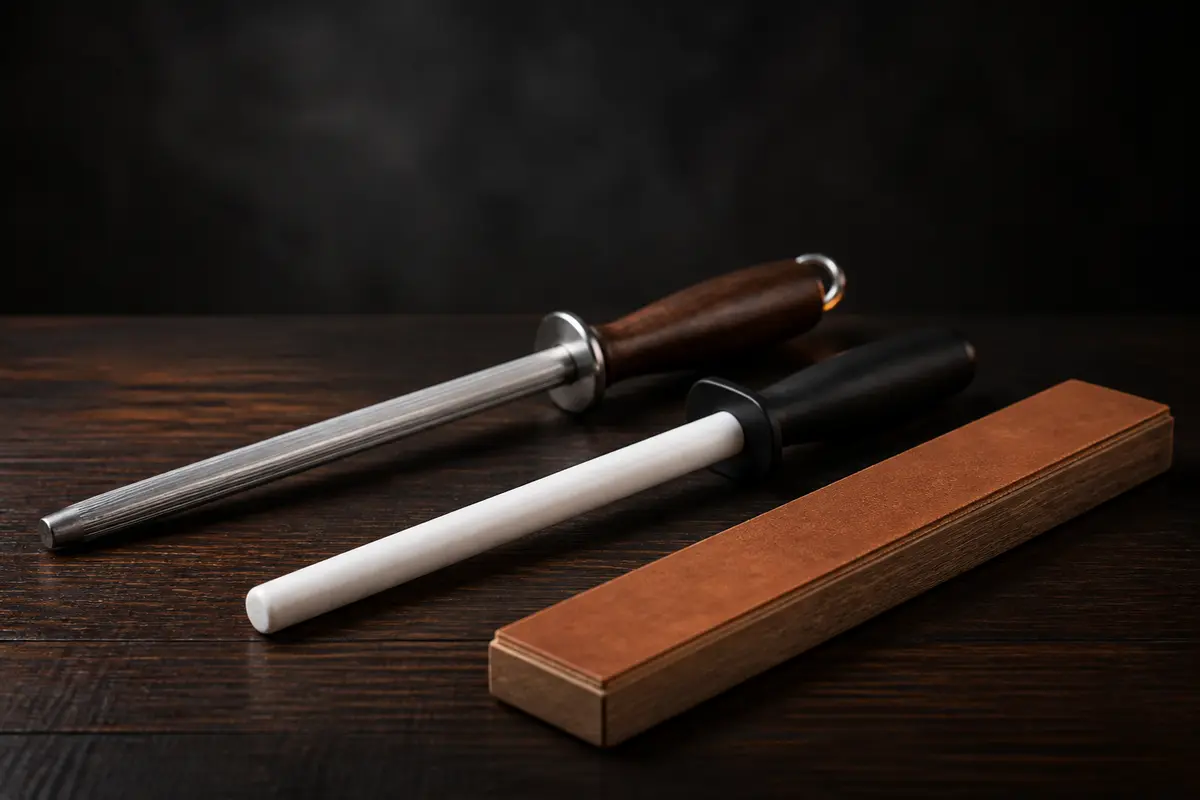
| Tool | What it does to the edge | Steel removed | On a 60+ HRC Japanese edge | Typical rating |
|---|---|---|---|---|
| Grooved (ribbed) steel | Grooves bite in and reset a rolled edge with a new micro-bevel | A little | Risky: shops say it can chip; Zwilling Japan rules its chrome-plated steel out at HRC 60+ | — |
| Smooth steel | Pushes the apex back and burnishes it; also leaves a narrow micro-bevel | Very little | A few light passes only; Verhoeven saw chipping after 15 | — |
| Fine ceramic rod | Abrades a tiny amount of steel; small micro-bevel | A little | The usual choice of specialist shops (Chef Knives To Go, Chubo) | e.g. Idahone Fine, sold as 1200 grit |
| Diamond rod | Closer to sharpening than honing; cuts fast | A lot | Has uses for quick repairs and very hard steels, but Chef Knives To Go says ceramic is almost always the right choice for routine maintenance; too aggressive in ATK’s test | — |
| Leather strop + compound | Polishes the bevel; reduced a coarse burr in Verhoeven’s tests | Almost none | Gentle; pull spine-first, at about your edge angle | e.g. 0.5 µm chromium oxide |
| Bare leather | Polishes and slowly abrades the apex; little visible change in Verhoeven’s tests | Next to none | Harmless, but does little | — |
Sources: Science of Sharp (micro-bevels), Verhoeven 2004 (passes, strop compound), Chef Knives To Go (HRC ranges, ceramic rating, diamond), Chubo, Zwilling Japan, America’s Test Kitchen. Ceramic “grits” are each seller’s own rating; they do not map exactly onto whetstone grits (compare grain sizes in our whetstone grit chart).
Ceramic rod vs diamond rod. A diamond rod cuts much faster. Chef Knives To Go calls diamond closer to sharpening than honing — with real uses for quick edge repair and very hard steels — but says ceramic is almost always the right choice for routine maintenance between sessions. America’s Test Kitchen found the diamond rods in its test too aggressive, and the author of Science of Sharp says a diamond rod destroys the apex. Kai in Japan does sell a diamond rod for both double- and single-bevel knives, as a quick sharpener rather than a hone. Keep diamond for repairs and follow it with a stone.
 Ceramic rod vs leather strop
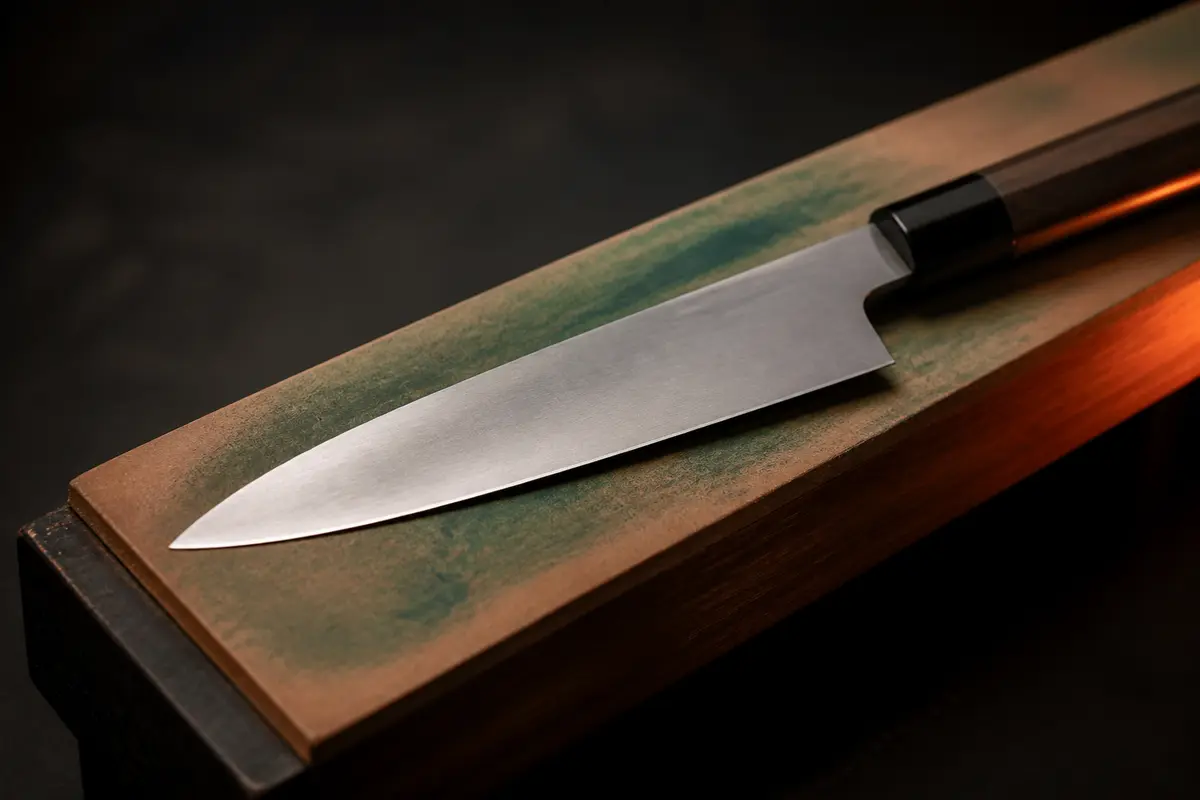
A rod and a strop are not rivals; they do different jobs. A ceramic rod abrades steel, so it can bring back an edge that has gone slightly dull or rolled in use. A strop polishes: it is the gentle last step after sharpening and a quick refresher in between.
The compound matters. In Verhoeven’s tests, plain leather made little visible difference to the burr or the sharpening scratches. Leather loaded with 0.5 µm chromium-oxide compound smoothed out the scratches left by #6000 and #8000 waterstones and shrank the larger burr left by a coarse 600-grit grinding wheel; on edges already finished on those waterstones, the burr stayed at about 0.5 µm wide. Science of Sharp describes leather as polishing the edge and slowly abrading metal from the side of the apex. Strop with the spine leading (the edge trails) at about the angle you sharpened at: Science of Sharp says no higher than the sharpening angle, while Verhoeven held his strop a few degrees steeper. Sharpeners often warn that a strop held much steeper rounds the apex over. Try both in the lab above.
How to hone a Japanese knife, step by step
- 1Check your maker
Read the care page for your knife. Some makers sell rods for their knives; others rule steel rods out above HRC 60.
- 2Pick a gentle rod
A fine ceramic or smooth rod. No grooved steel on a hard Japanese edge, and no diamond rod for routine touch-ups.
- 3
 Match your angle
Hold the blade at its own sharpening angle — about 15–16° per side. Shun’s steel has a 16° guide on the guard.
- 4Feather-light, heel to tip
Draw the edge down the rod from heel to tip with about the weight of the blade. Pressing harder bends or chips the apex.
- 53–5 strokes per side
Alternate sides. Chef Knives To Go suggests 3–5, ATK 4–5. In Verhoeven’s tests two back-and-forth passes beat fifteen.
- 6Then stop
If a few strokes don’t bring the edge back, the rod can’t help: sharpen on a whetstone.
Skip the rod for single-bevel knives (yanagiba, deba, usuba): Chef Knives To Go says to keep them on flat stones, because a round rod cannot follow the flat back. Skip it for a chipped edge too — a rod cannot remove a chip; see the repair guide and single-bevel vs double-bevel.
Hold the rod at your sharpening angle
The angle between the blade and the rod should match the angle the edge was sharpened at — about 15° per side on most Japanese double-bevel knives, 16° on Shun’s guide, 15° in America’s Test Kitchen’s instructions. Go a couple of degrees steeper and the rod meets the very apex; much steeper and it grinds a blunter micro-bevel (Verhoeven suggests no more than about 5° per side above the sharpening angle). Go flatter than the bevel and the rod only touches the shoulder, so nothing happens at the edge. Our sharpening angle calculator shows what 15° looks like on your blade.
When to stop honing and sharpen
A rod buys time; it cannot replace a whetstone. Each touch-up brings back a little less, because the rod is adding small micro-bevels on top of a bevel that is slowly wearing. Kai in Japan suggests sharpening on a whetstone once or twice a month as a general guide (and weekly if you rely on a simple pull-through sharpener). Shun says to sharpen only when honing no longer restores performance, which it puts at about once a year for many home cooks. Those two numbers are far apart — use them as the range, and let the knife tell you: when a few strokes on the rod no longer bring the edge back, go to the stone.
Sharpened on a whetstoneTouched up on a rod
When the rod stops helping, sharpen on a stone: how to sharpen a Japanese knife goes step by step. Which stones to use, and how big a jump between them, is in the whetstone grit chart. Keep the stone flat or it will round the edge you just honed — see how to flatten a whetstone. For washing, drying and storage, see the Japanese knife care guide.
When honing is no longer enough, see Japanese knife sharpening options.
Frequently asked questions
- Can you use a honing rod on a Japanese knife?
- Makers disagree. Shun sells a steel honing rod with a 16° angle guide for its own Japanese knives, while Zwilling Japan says its chrome-plated steel cannot be used on knives of HRC 60 or more, including Miyabi. Specialist shops such as Chef Knives To Go and Chubo warn that a grooved steel can chip a hard Japanese edge and suggest a fine ceramic rod. If you hone, check your maker’s advice, use a smooth or fine ceramic rod at your sharpening angle with 3–5 very light strokes per side. Chef Knives To Go says to keep single-bevel knives on flat stones rather than a round rod.
- Is a ceramic honing rod better than a steel one for Japanese knives?
- For hard Japanese knives (about 60–64 HRC), specialist shops generally prefer ceramic: Chef Knives To Go says grooved steels are designed for softer European knives and can chip harder Japanese ones. Under the electron microscope, Science of Sharp found that both ceramic and steel rods remove a little metal and leave a small micro-bevel, so neither is a “no-wear” tool; the difference is how aggressive the contact is.
- Ceramic honing rod vs leather strop: which should I use?
- They do different jobs. A ceramic rod abrades a little steel and can bring back a slightly dull or rolled edge. A strop loaded with fine compound polishes the edge after sharpening: in Verhoeven’s tests, leather with 0.5 µm chromium-oxide compound smoothed the scratches left by #6000 and #8000 waterstones and shrank the larger burr left by a coarse 600-grit grinding wheel, while plain leather made little visible difference. Many cooks use a rod between sharpenings and a strop as the last step of a whetstone session.
- Can you sharpen a Japanese knife with a steel?
- No. A rod only touches up an edge between sharpenings. Kai in Japan calls rods a simple touch-up tool and suggests a whetstone once or twice a month as a general guide; Shun says to sharpen when honing no longer restores performance, which it puts at about once a year for many home cooks. Chips and a worn, thick edge need a whetstone.
Sources
- Shun (Kai USA): sharpening vs honing (16° guide, heel to tip, light pressure)
- Shun (Kai USA): Classic combination honing steel 9" (smooth and micro-ribbed faces, 16° guide)
- Zwilling Japan: chrome-plated sharpening steel 23 cm (not for knives of HRC 60 and above, including Miyabi; 10–20°, 5–10 strokes per side)
- Zwilling US: Miyabi 9" sharpening steel
- Kai (Japan): whetstone maintenance (rods as a simple touch-up tool; keep the angle constant)
- Kai (Japan) FAQ: how often to sharpen (whetstone once or twice a month, simple sharpener weekly)
- Kai (Japan) online store: diamond sharpening rod AP0540 (for double- and single-bevel knives and scissors)
- Global (Yoshikin): knife care (whetstone sharpening is the best care)
- Chef Knives To Go: honing rods (grooved steel vs ceramic vs diamond, 3–5 strokes, single-bevel knives)
- Chubo Knives: sharpening stones FAQ (honing rods and Japanese knives)
- Korin: care note for its Western-style knives (honing steels and machines can chip; use stones)
- Science of Sharp: What does steeling do? Part 1 (SEM images: ribbed steel, smooth ceramic, smooth steel)
- Science of Sharp: What does stropping do? (SEM images)
- J. D. Verhoeven (Iowa State University, 2004): Experiments on knife sharpening (steeling and stropping under the SEM)
- America’s Test Kitchen: the best honing rods (nine rods compared)
- America’s Test Kitchen: how to use a honing rod (15°, light pressure, 4–5 strokes per side)
Checked 2026-11-02. We have not tested these rods ourselves; this page summarizes what knife makers, specialist shops and published microscope studies say, and shows where they disagree. Found a better source or an error? Tell us.