Buying guide · sources checked 2026-11-04Bringing a knife home from Japan
without losing the refund
Short answer: yes, you can bring kitchen knives back from Japan, but only in checked baggage. Purchases from November 1, 2026 add a trap: you pay 10% tax at the shop and get it back after a customs check, and that check needs the knife with you. So the order is customs, then bag drop, then security. Check the bag first and the Japan Tourism Agency says it cannot be pulled back: the knife flies, the refund does not.
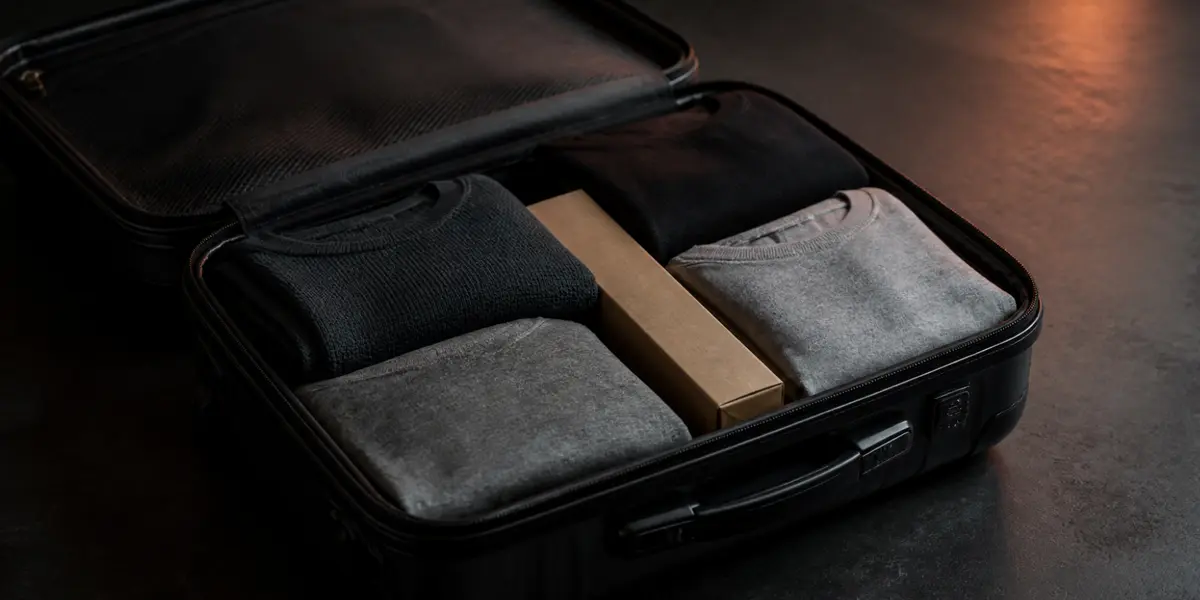
For choosing a knife and comparing total cost, see buying a Japanese knife from Japan. If the shop boxed your knife and your order below is right, you need nothing else.
 Airport order simulator: what comes first?
Here is the airport habit: bag drop first. Rearrange the stops and watch what happens to the knife and the refund.
Drag a card by its handle, or use Earlier and Later, to put the three stops in the order you would walk them.
- 1Bag dropThe suitcase with the knife goes to the airline
- 2
 Customs checkTax refund kiosk or Visit Japan Web, with every item on the receipt
- 3
 SecurityScreening for what stays with you in the cabin
Knife flies, refund is lost
The knife is already with the airline. The Japan Tourism Agency says the terminal cannot be used once goods are checked, and a checked bag cannot be pulled back for the procedure. Move Customs check in front of Bag drop.
The working order, step by step
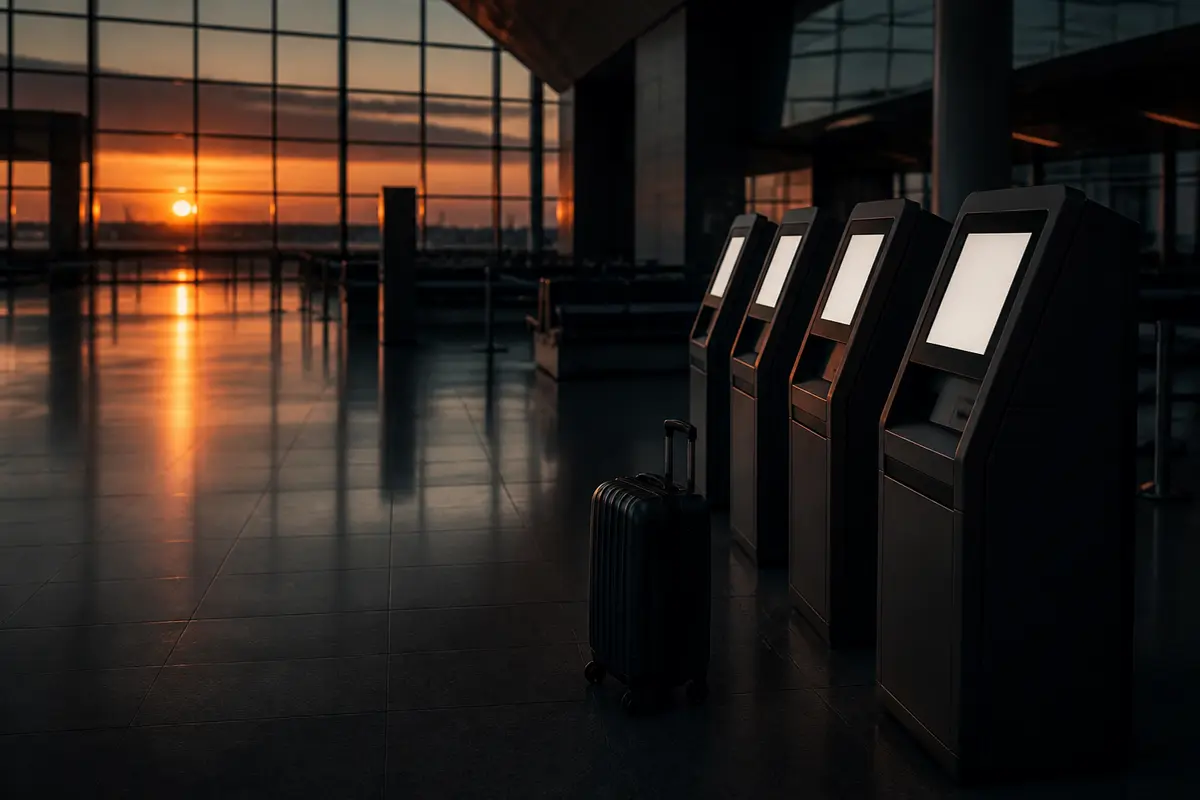
- 1Arrive early, bag in hand
Keep the suitcase with you in the lobby. The Tourism Agency says to allow plenty of time for an inspection.
- 2Do the customs check
Scan your passport at a tax refund kiosk. Seven major airports also take Visit Japan Web on dedicated Wi-Fi, which you register for after arriving in Japan.
- 3
 Green or red
Green ends it. Red sends you to the inspection area with every item on that receipt.
- 4Check the bag
Only now does the knife go to the airline, packed in the suitcase.
- 5Go through security
Nothing sharp on you. Passport control follows.
- 6Collect the refund
By the method the shop set up. At Kansai Airport, shops that offer cash pay it after passport control.
Four rules cause most of the trouble, all from the Japan Tourism Agency:
- One receipt, all or nothing. Customs confirms per transaction. If one item on a receipt is missing, nothing on that receipt is refunded, so a knife and a whetstone bought together travel together until the check is done. If you no longer have an item, skip the kiosk and tell a customs officer at the counter.
- 90 days. The check must happen within 90 days of purchase.
- No half-finished checks. Leave an inspection to catch your flight and it does not count. The airline and customs will not compensate you for a missed departure.
- Green is a duty, not just a pass. Goods confirmed by customs must leave Japan without delay. If they do not, the tax is collected and penalties can apply.
At Kansai Airport the procedure is for your day of departure only, and officers work from check-in opening until security closes. Purchases up to October 31, 2026 fall under the old system.
What the refund is worth
The refund is the consumption tax, and knives pay the standard 10%. Enter your price:
How the money comes back depends on the shop. Kansai Airport says methods vary by shop and refund provider: cashless refunds through the service set up at purchase, or yen after passport control if the shop offers it. Ask before you pay. Explore Osaka, a travel site and so a secondary source, reports a 1.55% fee at some department-store counters and says stores had not yet explained fees after the change. It also cites Kansai Airport’s retail company for timing: card refunds usually in one to two weeks, bank transfers in two to four.
 From the shop to the airport, stage by stage
Japan’s rules change along the way. Pick a stage and the drawing shows the packing that fits it.
At the shop: ask two questions
Pay the tax-included price and show your passport. Ask how the refund is paid, because the Japan Tourism Agency leaves the details to each shop and Kansai Airport says methods vary by shop and refund provider. Ask for an edge cover and a box too, and keep the receipt.
Source: Japan Tourism Agency; Kansai AirportOn the street: go straight back
Article 22 of Japan’s swords and firearms law bans carrying a blade over 6 cm without a work or other legitimate reason. Tokyo police give buying a blade at a shop and taking it home as an example of a legitimate reason, and say self-defense is not one. A visitor’s hotel is not spelled out, so keep it packed, head back, and do not take it sightseeing.
Source: Tokyo Metropolitan PoliceAt the hotel: keep it packed
The sources differ here. Kansai Airport asks you not to open, consume or use refund goods in Japan. The Japan Tourism Agency’s Q&A says goods other than consumables can still be confirmed after use, as long as they finally leave Japan. Leaving the knife in its packaging satisfies both, and the shop’s packaging also covers you on the train.
Source: Kansai Airport; Japan Tourism Agency Q&AOn the train: covered, wrapped, bagged
Japan’s rail rules ban blades on trains unless packed so they cannot harm anyone. For blades over 6 cm, the transport ministry’s guideline gives two examples: cover the edge with a sheath or cardboard, wrap the knife in newspaper or similar, and put it in a sturdy bag, box or case; or keep the shop’s packaging intact. Staff may check.
Source: MLIT Railway Bureau guideline, December 2018In the departure lobby: customs first
Bring the suitcase to the kiosk unchecked. The check must be on your day of departure, Kansai Airport says, and customs officers there work from check-in opening until security closes, while kiosks run 24 hours. Green ends it. Red means showing every item on the receipt to an officer.
Source: Japan Tourism Agency; Kansai AirportAt bag drop: into the hold
Now close the suitcase and check it. TSA says sharp objects in checked bags should be sheathed or securely wrapped to protect handlers and inspectors. Airlines can add rules: ANA’s page warns other carriers’ rules may apply on codeshares, so check the airline on your ticket.
Source: TSA; ANALanding at home: declare it
List the knife on your customs declaration. CBP says that if you are unsure, you should declare. If you collect your bag at your first US airport to connect, the knife goes back in the checked bag: TSA bans knives from carry-ons there too. State and local carry laws still apply on the way home.
Source: CBP; TSAThis is general information, not legal advice. The penalty under Japan’s swords and firearms law (Article 22) is up to two years’ imprisonment or a fine of up to ¥300,000 (Tokyo police). Japan’s Minor Offenses Act also covers carrying blades of any length concealed without a legitimate reason.
Domestic flights and other connections
The procedure happens at the airport where you leave Japan, so a train to that airport is the simple answer. Flying there first is harder, and Kansai Airport’s pages differ: the main page says not to check refund goods at your first airport and to keep them with you, such as in the cabin, while its FAQ also allows collecting the checked bag when you land at the departure airport. ANA’s domestic rules keep knives out of the cabin, which leaves the route its FAQ allows for a knife. We have not confirmed it for other airports, so ask your airline and airport before you fly.
- Suitcase stays with you
- Customs check
- Bag drop
- Refund and knife
- First airport: check bag to final city
- International airport: no knife with you
- No refund
- First airport: check bag only to the departure airport
- Collect it, then customs check
- Check it again
- Confirm first
On the way home, CBP describes connecting without re-checking bags as a special program on named routes, so be ready to handle your bag at your first US airport. If you do, keep the knife in the checked bag: TSA does not allow knives in carry-ons.
How to pack a knife for checked baggage
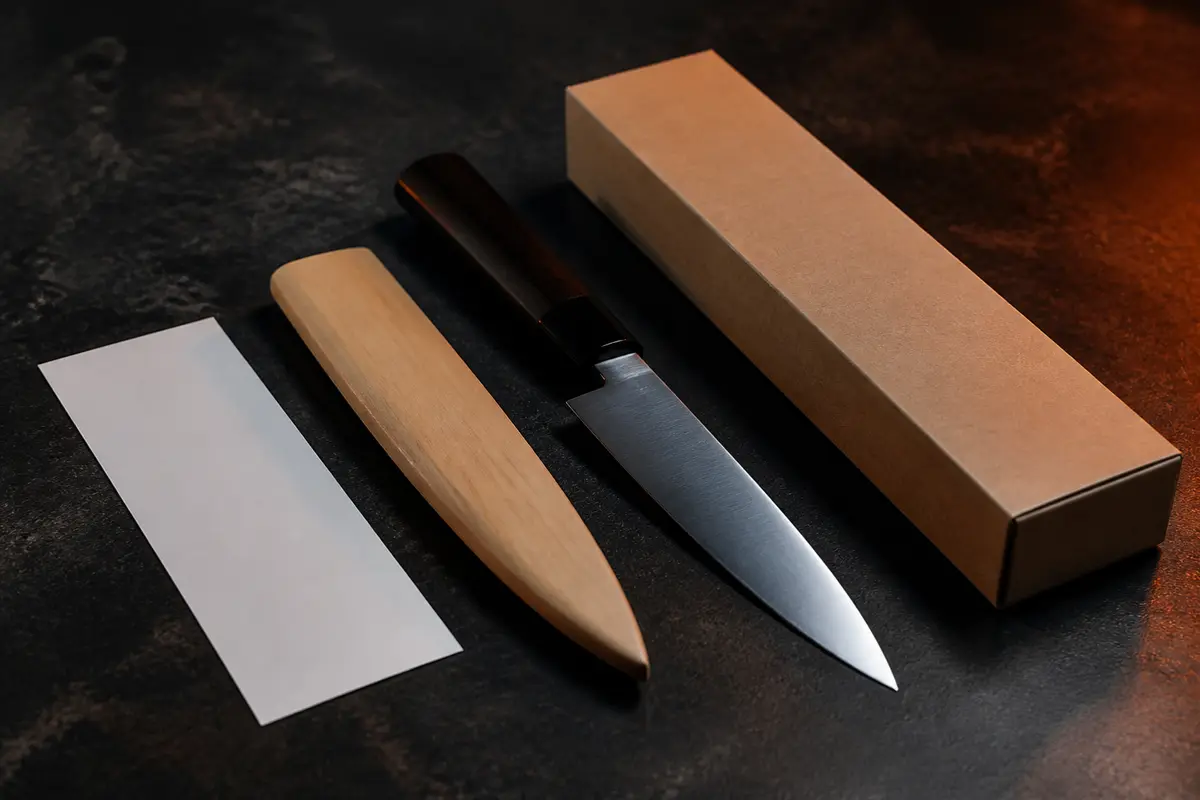
TSA asks only that sharp objects be “sheathed or securely wrapped” so they do not hurt baggage handlers and inspectors. The shop’s packaging may already do that. If not, here is a sensible order. It is our reading of that rule and Japan’s rail guideline, not an official standard:
- Cover the edge. A saya, an edge guard, or folded cardboard taped in place.
- Wrap the knife in paper or a cloth so the cover cannot slide off.
- Box or roll it. Keep the shop’s box if it fits.
- Pack it among clothes, away from the shell of the case, and leave it reachable until customs is done.
None of these make a knife carry-on legal. A sheath in your cabin bag still gets stopped at screening. And you may not need to buy anything: if the shop boxed the knife with a guard, you are done. With several knives, a roll keeps them together in one bundle inside the suitcase, though each edge still needs its cover.
 Customs at home: US, UK, Canada, Australia
The knife counts toward your duty-free limit, along with everything else you bought.
| Country | At the border | Knife rules |
|---|---|---|
| United States | Declare it. The exemption is for personal use, and if you used it in the past 30 days you generally have to wait. CBP’s Section 232 FAQ says the steel duties do not apply to duty-free Chapter 98 provisions, which include this exemption, but CBP has no traveler-specific statement, so ask if in doubt. | The Switchblade Knife Act covers blades that open automatically. CBP’s rule (19 CFR 12.96(b)) admits certain fixed-blade articles. State and local carry laws still apply. |
| Great Britain | Go over the allowance and you pay tax and duty on the total value, not just the excess. | The UK’s banned list names flick, gravity and disguised knives, among others, not ordinary kitchen knives. HMRC has the final say. Carrying most knives in public needs a good reason. |
| Canada | Report everything you bring back. | CBSA says all weapons must be declared. Its guide does not mention kitchen knives, so ask if unsure. |
| Australia | Check the ABF site before you fly. | ABF’s weapons page names daggers, star knives and throwing knives. We found nothing on kitchen knives, so ask ABF. |
Above the US exemption, CBP officers decide the duty; our import duty calculator gives the figures for ordering and shipping, not for travelers. Security rules differ by departure airport too: UK airports and Canadian airports both send kitchen knives to the hold.
 Carry it home or have the shop ship it?
- Japanese tax back, if you follow the order
- Inside your exemption, usually no US duty
- Airport steps and the packing are on you
- No kiosk and nothing sharp in your luggage
- About 31.1% US duty, plus carrier fees
- Exports are exempt from Japanese tax
Run your own numbers on the three-way cost comparison.
 Not going to Japan? Buy it in the US
All of this only applies if you are physically there. A US shop has already handled the import, and a return does not mean shipping a knife back to Japan, though each shop sets its own policy. Bernal Cutlery in San Francisco, for example, lists knives from Sakai Kikumori. If you are going, plan the day with our guide to visiting Sakai.
Frequently asked questions
- Can I bring knives back from Japan?
- Yes, in checked baggage. TSA, ANA and Kansai Airport all keep knives out of the cabin, and TSA asks that sharp objects in checked bags be sheathed or securely wrapped. Check your airline’s rules and declare the knife when you land.
- Can I put a knife in checked luggage in Japan if I want the tax refund?
- Yes, but only after the customs check. For purchases from November 1, 2026, the Japan Tourism Agency says you must have every tax-free item with you at the kiosk, the procedure cannot be done once the goods are checked, and a checked bag cannot be pulled back for it.
- Can you buy knives in Japan as a tourist, and are they tax free?
- Tourists can buy kitchen knives at shops, and Tokyo police list taking a knife home from a shop as a legitimate reason to carry one. Eligible visitors pay the tax-included price at a tax-free shop and get the 10% back after customs confirms export, as long as the purchase is at least ¥5,000 before tax at one shop in one day and the check is done within 90 days.
- What if I fly from another Japanese city before my international flight?
- Do the procedure at the airport where you leave Japan. A train to that airport is simplest. Kansai Airport says not to check refund goods at the first airport, and its FAQ also allows collecting the bag on arrival at the departure airport. Knives cannot go in the cabin, so for a knife the FAQ’s route is the one left. We have not confirmed it for other airports, so ask before you fly.
Sources
- Japan Tourism Agency: tax-free refund method for travelers (Japanese)
- Japan Tourism Agency: What is the Refund Method? (English)
- Japan Tourism Agency: Q&A on departure and customs confirmation (Japanese)
- Kansai Airport: tax refund information
- Kansai Airport: tax refund FAQ (Japanese page)
- Osaka Customs: guide to the refund procedure at Kansai Airport (PDF)
- Kansai Airport: carry-on restrictions
- ANA: items not permitted on board, international flights
- ANA: items not permitted on board, domestic flights
- TSA: What can I bring? Knives
- Tokyo Metropolitan Police: rules on carrying blades (Japanese)
- MLIT Railway Bureau: guideline on packing blades for trains, December 2018 (Japanese, PDF)
- CBP: what to expect when you return
- CBP: International Remote Baggage Screening
- CBP: Section 232 steel and aluminum FAQs (Chapter 98)
- CBP ruling HQ H029437 (quotes 19 CFR 12.96(b) on certain fixed-blade articles)
- GOV.UK: hand luggage restrictions at UK airports, personal items
- GOV.UK: bringing goods into Great Britain, personal allowance
- GOV.UK: guns, knives, swords and other offensive weapons at the UK border
- GOV.UK: selling, buying and carrying knives
- CATSA: knives with a blade over 6 cm
- CBSA: I Declare, a guide for residents returning to Canada
- Australian Border Force: prohibited goods, weapons
- Explore Osaka: tax-free shopping in Osaka (travel site, secondary source, updated September 30, 2026)
Checked 2026-11-04. Japan’s refund system started on November 1, 2026, and airports and shops are still publishing details, so check again before you travel. This is general information, not legal or customs advice; ask the airline, customs authority or police for your situation. We have not tested the products linked here. Found an error? Tell us.