Steel choice · sources checked 2026-11-04Carbon steel vs stainless
Japanese knives
Short answer: the difference is chromium. Carbon steels such as Shirogami and Aogami list 0–0.5%, so they rust if left wet and darken with a patina as you cook. Stainless steels such as Ginsan, VG-10 and SG2 list about 13–16% and mostly stay bright, though they can still spot. Neither is automatically sharper. Choose by how you dry a knife: wipe as you go → carbon. Dry after the meal → stainless, or a stainless-clad carbon core if you accept the odd spot at the edge. It sometimes sits wet → stainless.
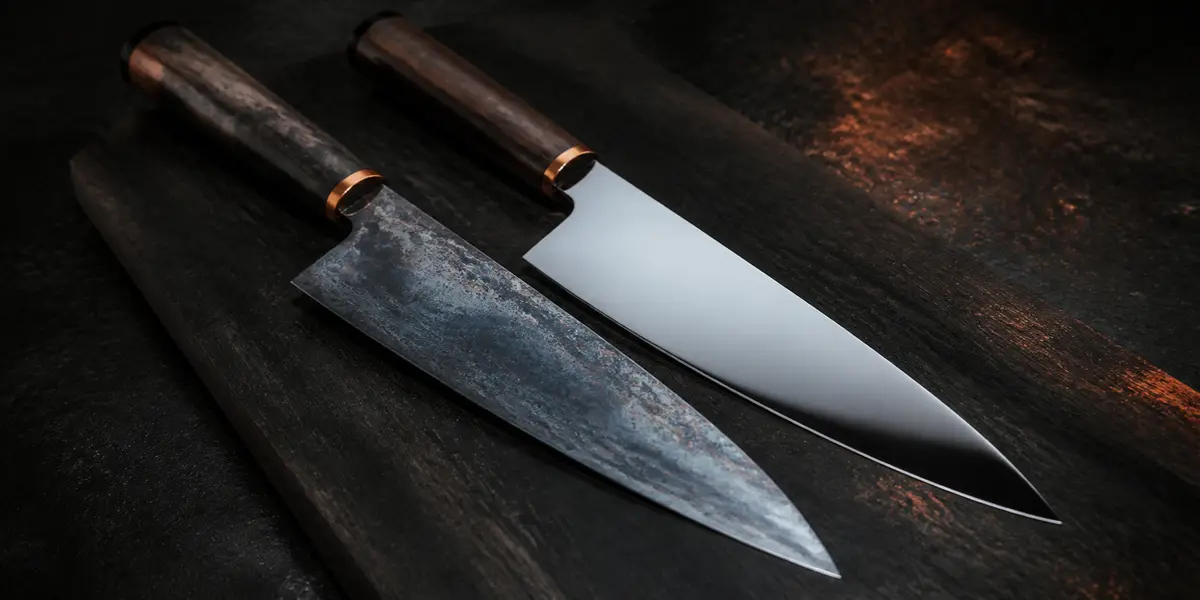
 Try it: what would your kitchen do to this blade?
Pick a steel, answer honestly, then drag the slider. Stainless steels get no patina layer in this picture; on carbon, how you dry the knife decides whether you get only patina or rust as well.
- Patina
- moderate
- Rust
- light
This picture explains how the steels behave. It is not a measurement or a forecast. Chromium figures are the steelmakers’ published values (a retailer figure for SG2); the amounts of patina and rust are our own illustration, ranked from what makers warn about: water, salt and acid. We found no published test that gives a rust rate for each habit.
 At a glance
| Carbon steel | Stainless steel | |
|---|---|---|
| Examples | Shirogami #1–#3, Aogami #1, #2, Super | Ginsan, VG-10, VG-1, AUS-8, AUS-10, SG2 (ZDP-189 is sold as stainless; see below) |
| Chromium listed | None listed (White) to 0.5% (Blue) | About 13–16% |
| If left wet | Kai: can rust in about 10 minutes, clad composites included | Kai: can still rust from chloride ions |
| Color change | Gray to blue-black patina with use | Stays bright in normal use |
| Lemon juice, 30–300 min in air (Knife Steel Nerds) | 1055 lost the most sharpness | 440A changed very little |
| On the stone | Easier in general; Kai says Aogami is harder work than Shirogami | High-carbide grades take more work; Takefu lists ease of sharpening as a VG-10 strength |
| Slicing edge retention | Lower wear resistance | Usually higher in high-carbide grades |
| Daily routine | Wipe during prep, dry at once | Wash and dry after use |
Chromium is from the steel chart on this site. Other rows are general trends from the sources below; the lemon-juice row used three inexpensive knives, and a single steel or maker can differ.
 What actually makes a steel stainless?
Kai defines stainless steel as at least 10.5% chromium and no more than 1.2% carbon, and says the chromium forms a protective oxide film. The steelmaker Alleima gives the same 10.5%. Knife Steel Nerds puts the cutoff at roughly 10.5–12%, depending on other elements. Here are the 15 steels in our chart against that line:
The chart holds two surprises. SLD crosses the line at 12% and is still only semi-stainless: Knife Steel Nerds notes that D2, its equivalent, is not considered stainless. And ZDP-189 tops the chart at 20%, and is advertised as stainless, yet Knife Steel Nerds measured only 8.6% chromium in solution and concluded that “it is not, in fact, stainless.” Chromium locked in carbides does not build the protective film, and Alleima says stainless knife steels “become stainless only after correct hardening, when carbides have been dissolved.” So the number on the label is a first guide, not a ranking of rust resistance. On carbon, SG2 and ZDP-189 also pass Kai’s 1.2% limit despite being sold as stainless: the word is shorthand, so read the composition.
 Is carbon steel actually sharper?
Some makers say so: Kai says good carbon-steel knives are hard and cut very well, and describes Shirogami’s edge as keen. What has been measured is narrower. We found no controlled test of Japanese carbon and stainless kitchen knives for sharpness, so here is what the steel research does support.
Edge-retention test: total card cut in 120 strokes (Knife Steel Nerds, CATRA)
- Carbide size matters more than the label. Knife Steel Nerds says the large carbides in 440C and 154CM make them harder to finish and sharpen, while low-carbide stainless such as AEB-L has carbides about as small as carbon steel’s. Alleima, which sells fine-carbide stainless, rates both carbon and fine-carbide steels “Excellent” for sharpness and coarse-carbide steels “Poor”.
- For edge retention, your sharpening can matter more than either. In its 48-steel edge-retention test, Knife Steel Nerds wrote that grit finish and edge angle have “a greater effect on performance than steel choice.” That is about how long an edge lasts, not how sharp it starts. See the sharpening angle calculator.
- High-carbide steels often last longer in abrasive slicing. The bars above are the published numbers, but that test cuts silica-loaded card, not carrots. For one matched pair, see Aogami Super vs SG2.
- Acid can roughen a carbon edge. Knife Steel Nerds dipped three inexpensive knives in lemon juice at pH 2.6 and left them in the air for 30 to 300 minutes. Plain 1055 lost the most sharpness and 440A little. The author believes the loss came mainly from a rougher edge, and says a strop or ceramic rod can bring it back. See honing rods for Japanese knives.
 Rust or patina? Choose the blade closest to yours
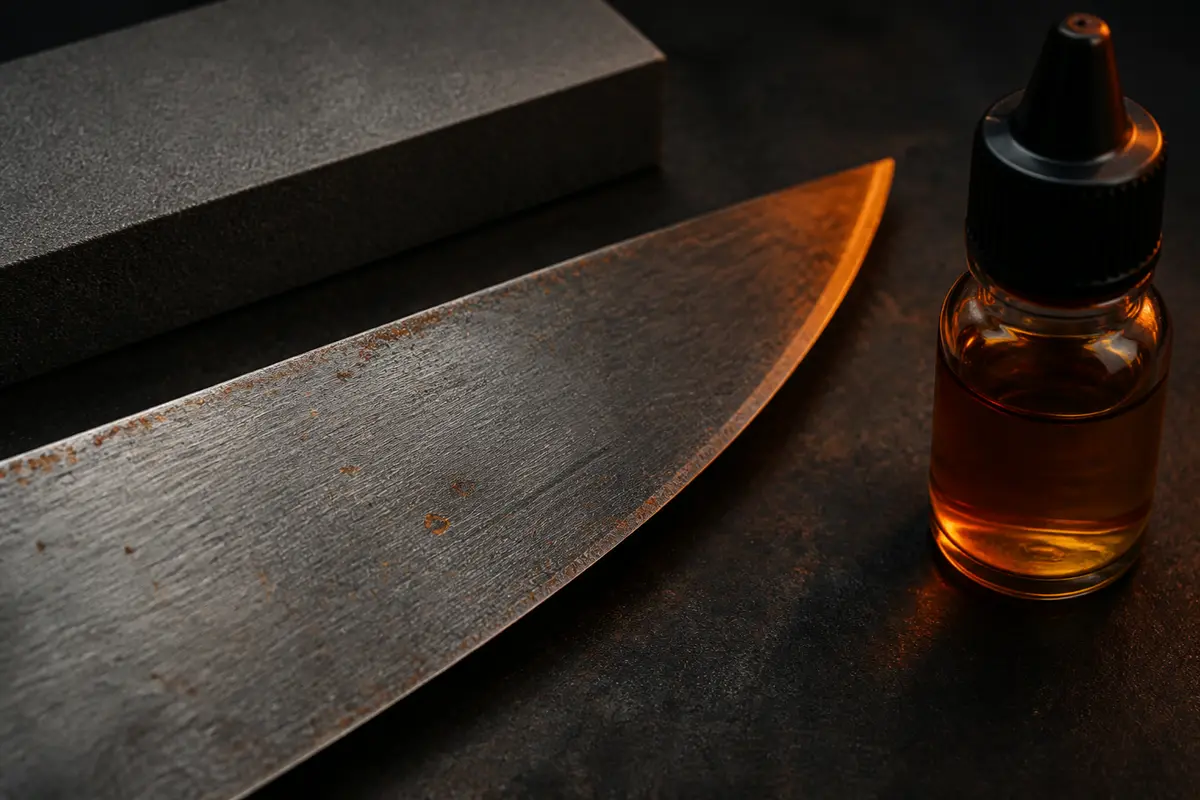
Both are iron oxides, so the worry before buying carbon is fair. America’s Test Kitchen describes patina as magnetite, a mild oxidation limited to the outer surface, and rust as hematite, which eats into the metal. A Japanese encyclopedia lists magnetite (Fe₃O₄) as black and red rust (Fe₂O₃·3H₂O and hematite, Fe₂O₃) as red-brown, and says red rust protects poorly and keeps degrading the iron if left.
Keep
Patina. Leave it.
Chefs Knives To Go’s rule of thumb: “blues, grays, and browns are patina, orange is rust.” It adds that a stable layer helps reduce further reactivity, so there is nothing to scrub off.
Keep
Patina. Leave it.
America’s Test Kitchen describes patina as a layer of magnetite that gives the knife a dark gray look and helps block further corrosion. A dark, even film is the look you are hoping for.
Check
Probably patina. Check by touch.
Brown is where advice splits: Chefs Knives To Go counts browns as patina, while Sharp Edge Shop and Sakai Jikko describe rust as brown. Sharp Edge says rust has a rougher texture, so if the spot feels rough, treat it as rust.
Remove
Rust. Remove it now.
Orange is the clearest sign. Sakai Jikko suggests a little powder cleanser on a soft sponge or a wine cork, or a rust eraser on the flat of the blade, and no hard sponges or scrub brushes. For deep rust, Kai says to resharpen on a whetstone.
Remove
Deep rust. It may not all come out.
Sakai Jikko warns that rust that has soaked in may not come off completely. Kai says deep rust can be sharpened out on a whetstone, though advanced rust can remain.
Remove
Rust, even on stainless.
Kai says stainless knife steel can still rust from chloride ions, and Tojiro warns that specks from tap water can grow into pinholes if left. Sakai Jikko says to rub them off gently with a rust eraser. We would do it early.
Nothing to buy. Keep cooking, wiping and drying.
Drawn to show typical colors and textures; these are illustrations, not photographs of real knives. Color varies with the steel, the finish and the light.
For the full removal steps and storage routine, see how to care for a Japanese knife.
 Should you plan on forcing a patina?
It is tempting to plan on darkening a new blade on day one and being done with rust. The one published trial we found points the other way. America’s Test Kitchen soaked a carbon-steel knife in vinegar: the blade came out with a rough surface that dragged on food and rusted more easily. Knives that formed a light patina through use were less likely to rust when left wet. So do not count on a shortcut when you decide. A patina builds with normal use, and it reduces rust without removing the need to dry the knife.
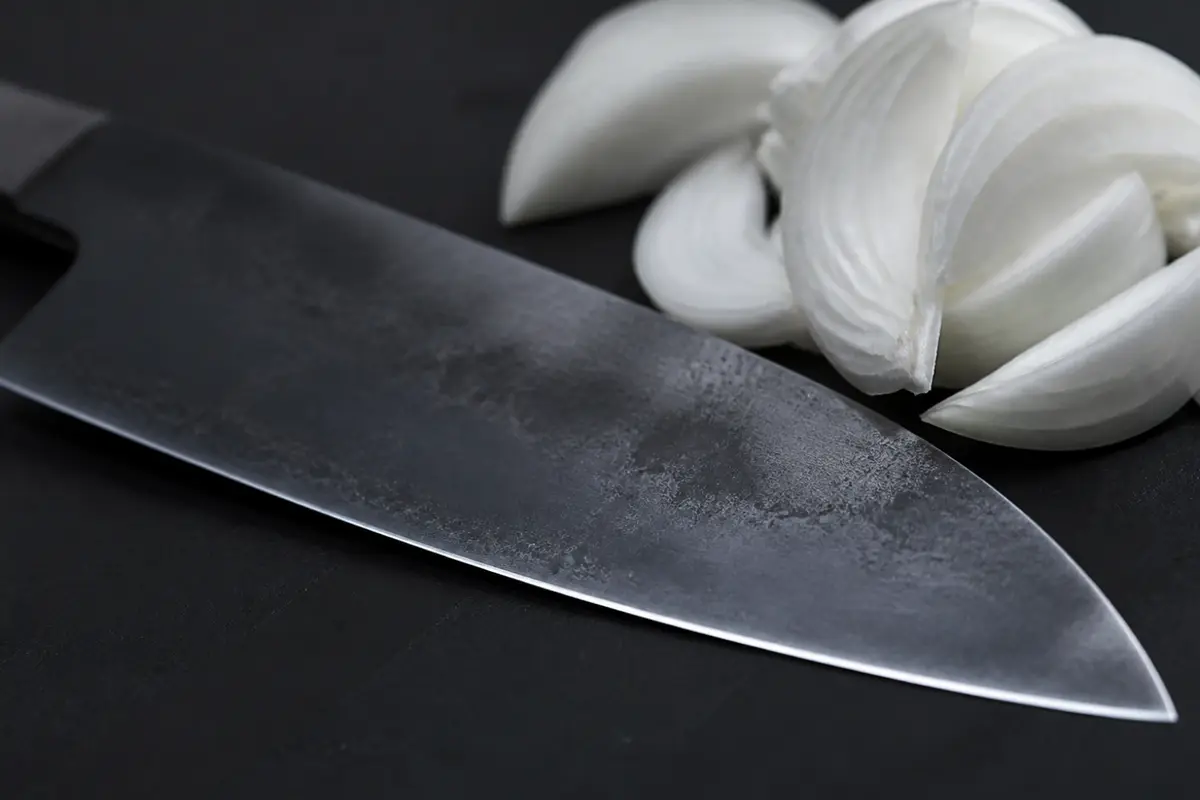
 The third option: a carbon core in stainless cladding
You do not have to choose one steel for the whole blade. On a clad knife the hard core makes the edge and a softer layer forms the flats, so the cladding decides how much of the blade can rust. How san-mai and warikomi are built has the details; here is what it means for upkeep:
Bernal Cutlery lists stainless-clad gyuto in Aogami and Shirogami core steels from several makers, so this is an easy route to find. It is not rust-proof. Kai’s FAQ lists carbon steel and composite knives together and says that, with water or food left on them, they can start to rust in about 10 minutes. So wipe the edge after acidic food, and if you dry only after the meal, expect the odd spot along the edge.
 Which one fits your kitchen?
The steel matters less than what happens in the minute after you stop cutting. Here is the routine you are signing up for with each one:
- StainlessWash and dry after you cook. Skip the dishwasher, as with any Japanese knife. Tiny spots can still appear; rub them off early.
- Stainless-clad carbonThe same wash and dry, plus a wipe along the edge after acidic food. Expect a thin gray line of patina at the edge, and the odd rust spot if you dry only after the meal.
- CarbonA towel by the board. Wipe between ingredients, wash at once and dry straight away. A thin film of oil if it will sit unused; Kai and Jikko accept ordinary cooking oil.
| If… | Look at |
|---|---|
| Other people use the knife too (plan for the least careful one) | Stainless |
| The knife goes in the sink until after dinner | Stainless |
| You like the idea of carbon but are not sure you will keep up | Stainless-clad carbon, accepting the odd spot at the edge |
| You already keep a towel at the board, and want to learn on stones | Carbon; Kai points people who enjoy sharpening to carbon, and says Aogami is harder work than Shirogami |
| You cook acidic food in a humid kitchen | Stainless, or clad if you wipe often |
If you already own a stainless knife you like, you do not need to replace it. Steel alone will not transform your cooking, and a sharper edge on what you own costs far less. Next, compare specific grades in the Japanese knife steel chart and Ginsan vs VG-10, or read the buying guide.
Frequently asked questions
- Do carbon steel Japanese knives rust?
- Yes. Shirogami lists no chromium and Aogami lists up to 0.5%, far below the 10.5% that Kai gives for stainless steel. Kai says carbon-steel knives can rust in about 10 minutes if water or food is left on them. Wiping during prep and drying right after washing prevents most of it, and the gray-blue color they take on is patina rather than rust.
- Is patina the same as rust?
- No. America’s Test Kitchen describes patina as a layer of magnetite, a mild oxidation that stays on the outer surface and helps block further corrosion, while rust (hematite) is more aggressive and eats into the metal. Chefs Knives To Go’s rule of thumb is that blues, grays and browns are patina and orange is rust, and Sharp Edge Shop adds that rust has a rougher texture.
- Is carbon steel sharper than stainless?
- Kai, a Japanese maker, says good carbon-steel knives cut very well, but we found no controlled test of Japanese carbon and stainless kitchen knives. Knife Steel Nerds says large carbides make some stainless steels harder to finish and sharpen, while low-carbide stainless has carbides about as small as those in carbon steel. Its 48-steel test is about how long an edge lasts: there, sharpening finish and edge angle had more effect than steel choice.
- Should I force a patina on a new carbon knife?
- You do not need to. When America’s Test Kitchen tried a vinegar soak, the blade came out rough, dragged on food and rusted more easily, while knives that built a light patina through use were less likely to rust when left wet. Use the knife and dry it, and the patina arrives on its own.
Sources
- Kai: the appeal of carbon-steel (hagane) knives (stainless defined as ≥10.5% Cr and ≤1.2% C; Aogami harder to sharpen)
- Kai: FAQ, why did my knife rust? (chloride ions; carbon and composite knives can rust in about 10 minutes; whetstone for deep rust)
- Tojiro: knife care (specks from tap water, pinholes)
- Sakai Jikko: removing rust (cleanser, cork, rust eraser on the flat, scratches, Damascus caution, no hard sponges, deep rust)
- Knife Steel Nerds: Carbon vs Stainless Steel in Knives (10.5–12% Cr; D2; carbide sizes; low-carbide stainless)
- Knife Steel Nerds: Does Acidic Food Affect Edge Retention? (lemon juice, pH 2.6; 1055, D2, 440A)
- Knife Steel Nerds: Corrosion Resistance vs Hardness (chromium in solution: ZDP-189 8.6%, “not, in fact, stainless”; D2 7.7%)
- Knife Steel Nerds: Testing the Edge Retention of 48 Knife Steels (CATRA)
- Alleima: different knife steel types (10.5% Cr; carbides dissolved in hardening; property table)
- Proterial: YSS Gin 3 (“hardness and sharpness comparable to carbon steel”; 13.00–14.50% Cr)
- Takefu Special Steel: V Gold No.10 (VG-10)
- America’s Test Kitchen: carbon steel knives, why a patina matters (magnetite vs hematite; vinegar test)
- Chefs Knives To Go: carbon steel care guide (color rule, acidic food)
- Sharp Edge Shop: rust vs patina (colors; rust has a rougher texture)
- Kotobank: 錆 (rust), Heibonsha World Encyclopedia (Fe₂O₃·3H₂O, Fe₂O₃, Fe₃O₄)
- Knives and Stones: White vs Blue steel (on clad knives the cladding is the reactive face; stainless cladding leaves only the thin edge reactive)
- Bernal Cutlery: stainless-clad Aogami and Shirogami listings
Checked 2026-11-04. We have not tested these knives ourselves. Where we could not find a measurement, we say so and attribute the view to the maker or shop that holds it.