Care & sharpening · sources checked 2026-11-04Where and how to get
Japanese knives sharpened
Short answer: if you will learn, buy a whetstone, the method Shun and Chef Knives To Go both recommend. If you won’t, mail it in: Bernal Cutlery charges $1.75–$3 an inch plus $12 return shipping, and Chef Knives To Go lists $20. A 15° electric is fastest, but sources disagree about machines on Japanese edges. For single-bevel knives, use flat stones or a shop that lists them: Kai says its pull-through cannot be used on them.
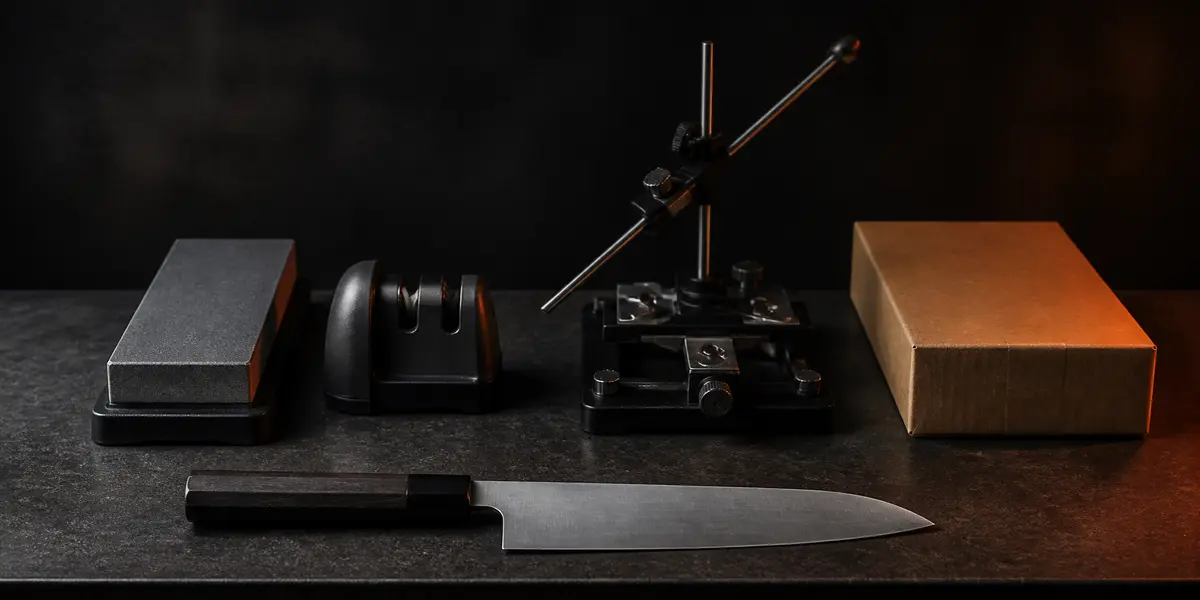
Mailing your knives instead? You probably have nothing to buy: the shops ask for newspaper and a strong box.
 Find your route
Choose your edge, your steel and how much effort you want to spend. Not sure which edge you have? Our guide to single-bevel vs double-bevel knives shows how to tell. Chef Knives To Go puts Western knives at 56–58 HRC, VG-10 at about 60–62 and R2/SG2 at 63–65; a maker’s own figure beats these general ranges.
Pick a route to see where it touches the edge. Angles are enlarged so you can see them.
Start with: A combination whetstone
Shun and Chef Knives To Go both recommend it, and a flat stone works on double- and single-bevel knives alike. Expect a learning curve: America’s Test Kitchen says to practice on a cheap knife first.
Ratings are SAKAI EDGE’s summary of the maker, tester and shop statements listed in the sources. They are not our own test, and we have not tried these tools. “Sources split” means the sources we read disagree. Steel hardness changes the answer in one case only: sending a 63+ HRC edge to a shop instead of a machine is our own cautious call, not a published limit.
 Where to send knives: mail-in sharpening for US customers
These are the services open to US customers that we could confirm on their own pages, listed A to Z. “Not listed” means the page we read does not say, so ask. A send can take a month, so plan around the holidays: Bernal warns that it is busiest leading into the end of the year.
| Shop | Where | Double-bevel | Single-bevel | Return shipping | Turnaround | First step |
|---|---|---|---|---|---|---|
| Bernal Cutlery | San Francisco, CA | $1.75/in wheel and strop; $3/in hand finish | $5/in | $12, insured and tracked; more above $1,000 insured value | About 4 weeks; rush 48–72 hours | Create an account, print the form, mail it. Estimate in 24–48 hours |
| Chef Knives To Go | Fitchburg, WI | $20 listed; confirm it is per knife | Not listed | Not listed | Not listed | Order the service online, then mail the knife |
| Chubo Knives | Online; some shipping handled from Japan, so ask where knives go | $14 (“Western style chefs knives”), shipping not stated | $20, shipping not stated | By email | Not listed | Email them for shipping and payment details |
| Japanese Knife Imports | Beverly Hills, CA | $25; wide-bevel double-bevel $60 | From $60 | Not listed | Depends on backlog | Contact them first: mail-in is “may be able to”, and they ask for photos. Five knives at most; service can be suspended |
| Knife Aid | Mail only | Seven knives $89–$99 one time (the site showed both on 2026-11-04); packs of 4–14 | Not listed | Free, prepaid envelope | Not listed | Order online. Ask about your grind first |
| Korin | New York, NY | $25 (Western-style knives) | Only knives bought from Korin; sent to Japan | Not stated; UPS label emailed to you | Takes 2–3 days to process; traditional knives about 3 weeks | Fill in the online form. Two knives minimum |
| Seisuke Knife | Portland, OR | $50 for one, $117 for six; under 13 in | Not listed | Box and prepaid label included | Up to a week after arrival | Order online. They send you the box |
| Shun (Kai USA) | Portland area, OR | Free for Shun knives, at 16° | Free for Shun knives, factory style | $15 shipping and processing | About 2 weeks; allow up to six with delivery | Submit the online form. Bought in the US, Canada or Mexico only |
Published prices checked 2026-11-04. Some are per inch and some per knife, and repairs cost extra. Bernal Cutlery is one of our affiliate shops for products; the service links in this table are plain links that earn us nothing.
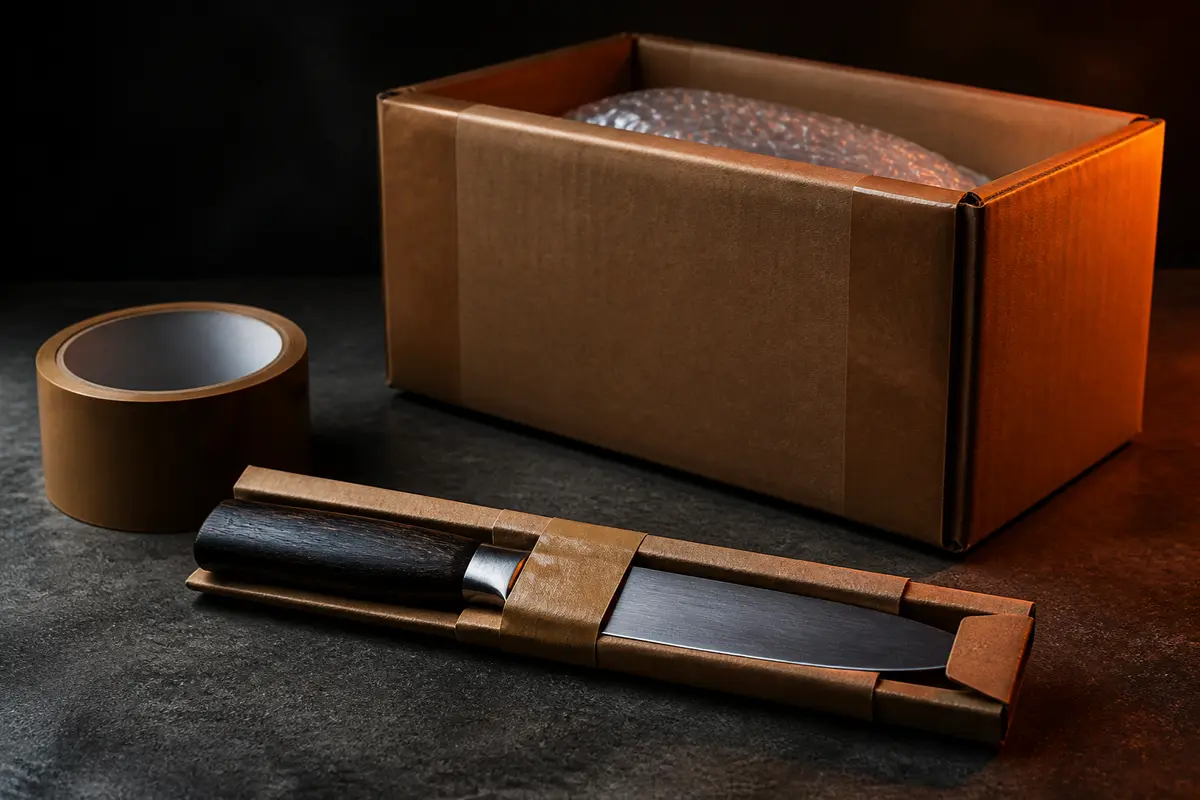
How to pack a knife for the mail
- 1Ask first
Fill in the form or email the shop. Shun returns parcels with no order number; Japanese Knife Imports asks you to speak with them before sending anything.
- 2
 Clean and dry
Bernal charges $5 a knife for dirty blades. Shun says knives must be clean and free of dirt, oil and food.
- 3Wrap each knife
Use newspaper or paper bags and cover the tip. Bernal says no towels and no tape directly on the knife.
- 4
 Keep the extras
Korin says not to include blade covers, boxes or sayas (wooden sheaths). Shun recycles boxes sent with knives. Ask if your saya must travel.
- 5
 Stop the rattle
Use a strong box and pad above and below, so tips and edges cannot move. Korin says no padded envelopes.
- 6Ship with tracking
Shun says it cannot be responsible without proof of delivery. Keep a copy of your form.
 Whetstones: the route that handles both edges
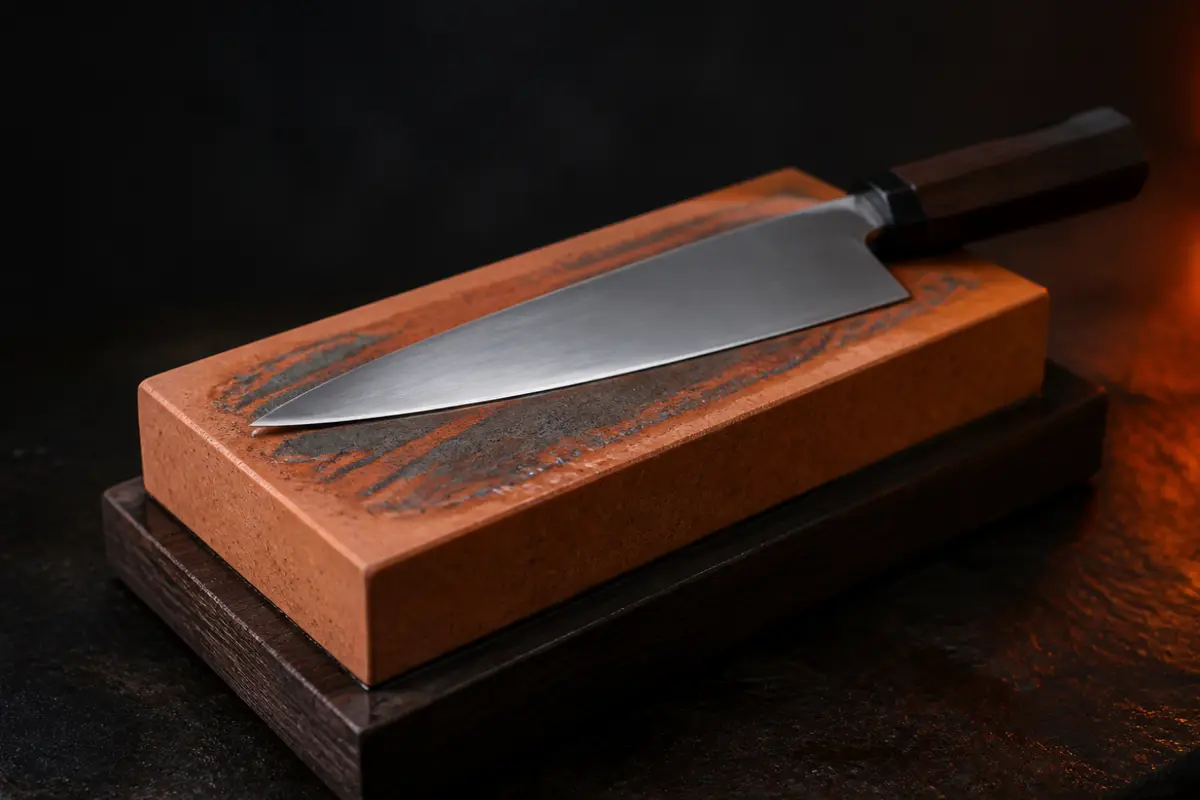
Shun calls a whetstone the recommended method for anyone who prefers a hands-on approach, and Chef Knives To Go says the same for Japanese blades. Kai goes further: after a simple sharpener stops helping, it tells owners to go back to a flat stone. The cost is time. America’s Test Kitchen says much practice is required and suggests starting on a cheap knife.
We don’t repeat the technique here: the steps are in how to sharpen a Japanese knife on a whetstone. Then see which grits to buy, how high to hold the spine and how to keep the stone flat.
Single-bevel knives need a different habit: the wide bevel goes down flat, and the back gets only a light touch. Shun says its single-bevel blades have a micro-bevel on the back, which lets you touch up the edge with a smooth hone or a 6000-grit whetstone.
Guided rigs: keep the stones, lose the guesswork
A rig clamps the blade and runs an abrasive along a fixed rod. A clip-on guide is simpler: it sets the spine height while you work on your own stone. Either one answers the hardest part of freehand sharpening, which is holding one angle across the whole stroke. Most Japanese double-bevel knives sit near 15° per side (see the angle calculator), so check that the rig goes that low.
On single-bevel knives, follow the rig maker’s own method. Wicked Edge’s method sharpens only the beveled side and tells you to go gently on the flat side so you don’t create a second bevel.
 Pull-through and electric: who says what
Here is what each side says in its own published material:
Makers
- Kai (Japan), the group behind Shun Marks its Seki Magoroku pull-through double-bevel only, and rules its compact electric out for single-bevel, serrated, ceramic and thick knives. Source · Source
- Chef’sChoice Says the 15XV gives a 15° edge in about a minute. The Model 15 manual, which gives its main facets as 14°, has a single-bevel method: it hones the bevel through one side’s slot and gives the back only a pull or two in the polishing stage. Source · Source
Testers
- America’s Test Kitchen Its winning electric, the Trizor XV, took about 2 minutes and repaired chips. It also lists whetstones and professional sharpeners as options. The article is not specific to Japanese knives. Source
Specialist shops
- Chef Knives To Go Recommends whetstones and says pull-throughs and electric grinders remove too much metal and can damage a Japanese blade’s geometry. Source
- Chef’s Armoury Says a pull-through will permanently damage single-sided blades, and that ceramic wheels can chip thin Japanese blades. Source
- Korin For its own thin Western-style knives: machines may cause chipping, so use stones. Source
Two practical points come out of this. First, check the angle. Chef’sChoice sells its 15XV as a way to turn 20° edges into 15° edges, and Shun works to 16°, so a machine set for a Western 20° will not match. Chef’s Armoury adds that many Japanese knives have offset bevels, which a fixed slot cannot know about. Second, expect a limit. Kai says a simple sharpener mainly refreshes the very edge, so with repeated use only the tip wears and the edge comes back less each time. At that point it sends you to a flat stone. It also says simple sharpeners need use about weekly, against once or twice a month for a stone.
We found no independent measurement of how much steel each route removes on a Japanese knife, so treat “too much metal” as the view of shops that also sell whetstones, not a tested figure.
Why single-bevel knives are different
Double-bevelBoth faces are ground, so a two-sided slot has something to follow.
Single-bevelThe back is flat or slightly hollow. A two-sided slot would grind it too.
 What five years costs
Gear is paid for once and mail-in costs money every time, so the answer depends on how often you sharpen. It starts with two 210 mm knives (about 8.25 inches) sent to Bernal once a year for a hand finish. A guided rig has no standard price, so enter yours.
The chart favors gear because it ignores what gear asks of you: practice, mistakes and the steel you remove while learning. If you own a Shun, try the Shun option in the shop list: the sum is very different.
When sharpening isn’t the job
 Dull, but no damage
Try a rod first if your maker allows it. Shun says to sharpen once honing stops helping. See honing rods for Japanese knives.
Small chip or bent tipShops price this as an extra: Bernal from $5, Japanese Knife Imports from $5, Chubo from $20, Chef Knives To Go $35. Shun takes chips of 2 mm or less. See the chipped knife guide.
Large chip or crackShun will not repair large chips or cracks, and says severe ones may not be repairable. Send photos to a shop before you mail anything.
Frequently asked questions
- Where can I get Japanese knives sharpened?
- In the US you can mail them to a shop that sharpens by hand or on water-cooled wheels. Bernal Cutlery in San Francisco charges $1.75 to $3 an inch plus $12 return shipping, Chef Knives To Go lists $20, and Japanese Knife Imports charges $25 by arrangement. Shun sharpens its own knives free for a $15 shipping and processing fee. Prices were checked on 2026-11-04, so confirm them before you send anything.
- Can you use a pull-through sharpener on a Japanese knife?
- On double-bevel knives, sources are split. Kai sells double-bevel pull-throughs and says they mainly refresh the very edge, while Chef Knives To Go says pull-throughs remove too much metal and can damage a Japanese blade’s geometry. On single-bevel knives, Kai says its pull-through cannot be used and Chef’s Armoury says it will permanently damage the blade.
- Can you use an electric knife sharpener on Japanese knives?
- It depends on the knife and the machine. Look for a 15° setting on double-bevel knives. Chef’sChoice sells 15° models and its Model 15 manual includes a single-bevel method, while Kai rules its own compact electric out for single-bevel knives. Chef Knives To Go says electric grinders remove too much metal, and Korin warns that machines may chip its thin knives.
- What is the best way to sharpen a Japanese knife?
- Shun and Chef Knives To Go both recommend a whetstone if you want to do it yourself, and Shun says the easiest way for its own knives is its free service. America’s Test Kitchen notes that whetstones take a lot of practice. There is no single best route: it depends on the edge and how much effort you want to spend.
Sources
- Bernal Cutlery: sharpening services (rates, mail-in steps, $12 return shipping, turnaround)
- Bernal Cutlery: store search for combination stones (Takarazukushi 1200/4000, $82)
- Chef Knives To Go: knife sharpening by mail ($20; chip or tip repair $35)
- Chef Knives To Go: Japanese knife steel guide (whetstones; pull-throughs and electric grinders; HRC ranges)
- Japanese Knife Imports: knife sharpening services (prices, mail-in by arrangement)
- Korin: sharpening service (prices, form, packing, traditional knives)
- Korin: care note for its Western-style knives (machines may cause chipping)
- Chubo Knives: knife sharpening service
- Chubo Knives: contact page (some customer service and shipping handled in Japan)
- Seisuke Knife: TAKUMI mail-in sharpening
- Knife Aid: mail-in knife sharpening
- Shun (Kai USA): sharpening service (fee, single-bevel, packing)
- Shun (Kai USA): sharpening Q&A (chips of 2 mm or less)
- Shun (Kai USA): sharpening vs honing (about once a year; whetstone recommended)
- Kai (Japan): Seki Magoroku diamond and ceramic sharpener (double-bevel only)
- Kai (Japan): compact electric sharpener (not for single-bevel, serrated, thick or ceramic knives)
- Kai (Japan) FAQ: what a simple sharpener can and cannot do
- Kai (Japan) FAQ: how often to sharpen
- Chef’sChoice: 15XV electric sharpener (15° edge, list price)
- Chef’sChoice: Model 15 manual (single-bevel procedure)
- Chef’sChoice: Pronto manual (15°, two discs sharpen both sides at once)
- Chef’sChoice: Pronto Model 463 (15°, double-sided knives, list price)
- America’s Test Kitchen: which knife sharpening method is right for you
- Chef’s Armoury: the truth about pull-through knife sharpeners (a shop’s view)
- Wicked Edge: how to sharpen a single-beveled blade
Checked 2026-11-04. We have not tested these tools or services ourselves; this page summarizes what makers, testers and shops publish, and shows where they disagree. Found a better source or an error? Tell us.