Knife shapes · sources checked 2026-11-02Petty knife vs
paring knife
Short answer: a petty is the small Japanese utility knife — Kai and Tojiro both give 120–150 mm, and Kai says it suits work in the hand and fine cuts. A paring knife is shorter: Wikipedia gives 6–10 cm (2–4 in), for peeling and small, intricate work in the hand. By length, a petty overlaps the Western utility knife (Wikipedia: 10–18 cm). If you want one small knife that peels in the hand and also trims and slices on the board, look at a 120 mm petty; if you only peel and core, a paring knife does the job.
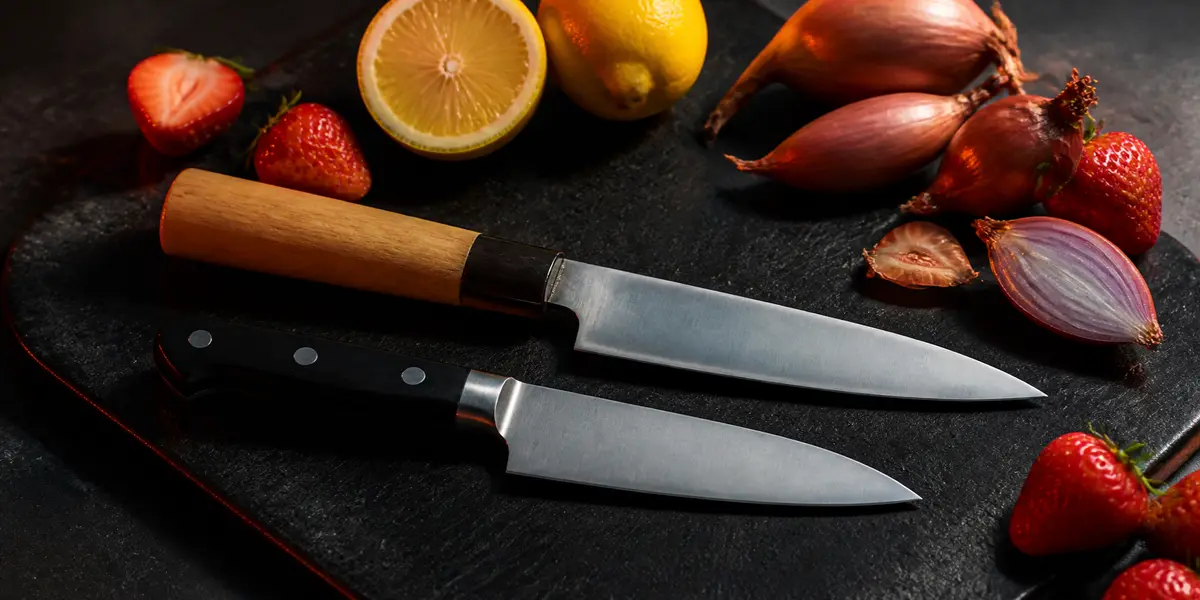
The names overlap because different sources draw the lines in different places. Slide the length below: the knife is drawn to the ruler’s scale, and each bar lights up when that source would call a knife of this length by its name.
120 mm (4.7 in): a petty knife to Kai, Tojiro and Wikipedia; a utility knife to Wikipedia. Longer than Wikipedia’s paring range (6–10 cm).
 At a glance
| Petty | Paring knife | Utility knife | |
|---|---|---|---|
| Where it comes from | Japan; a Western-style knife adopted from the Meiji era | Western kitchens | Western kitchens |
| Usual length | 120–150 mm (Kai, Tojiro); Wikipedia: 10–18 cm | 6–10 cm (Wikipedia); Tojiro Classic: 90 mm | 10–18 cm (Wikipedia) |
| Blade | More triangular, straight edge (ATK) | Short, with no heel or choil (Wikipedia) | Narrow, often slightly curved (ATK) |
| Made for | Work in the hand and fine cuts (Kai); smaller produce (Wikipedia) | Peeling fruit and vegetables, small intricate work (Wikipedia) | Mid-size prep (ATK) |
| Name | Probably from French petit, “little” (Josh Donald, via ATK) | “Paring” = peeling | Sometimes called an office knife (ATK) |
ATK = America’s Test Kitchen. From Kai, Tojiro, Wikipedia, ATK and a Tokyo Metropolitan Board of Education teaching document. Sizes are what the sources publish; individual knives vary.
In the hand and on the board (Kai, Tojiro).

Peeling and small work in the hand (Wikipedia).

The Western name for the same size class (Wikipedia).
The petty knife
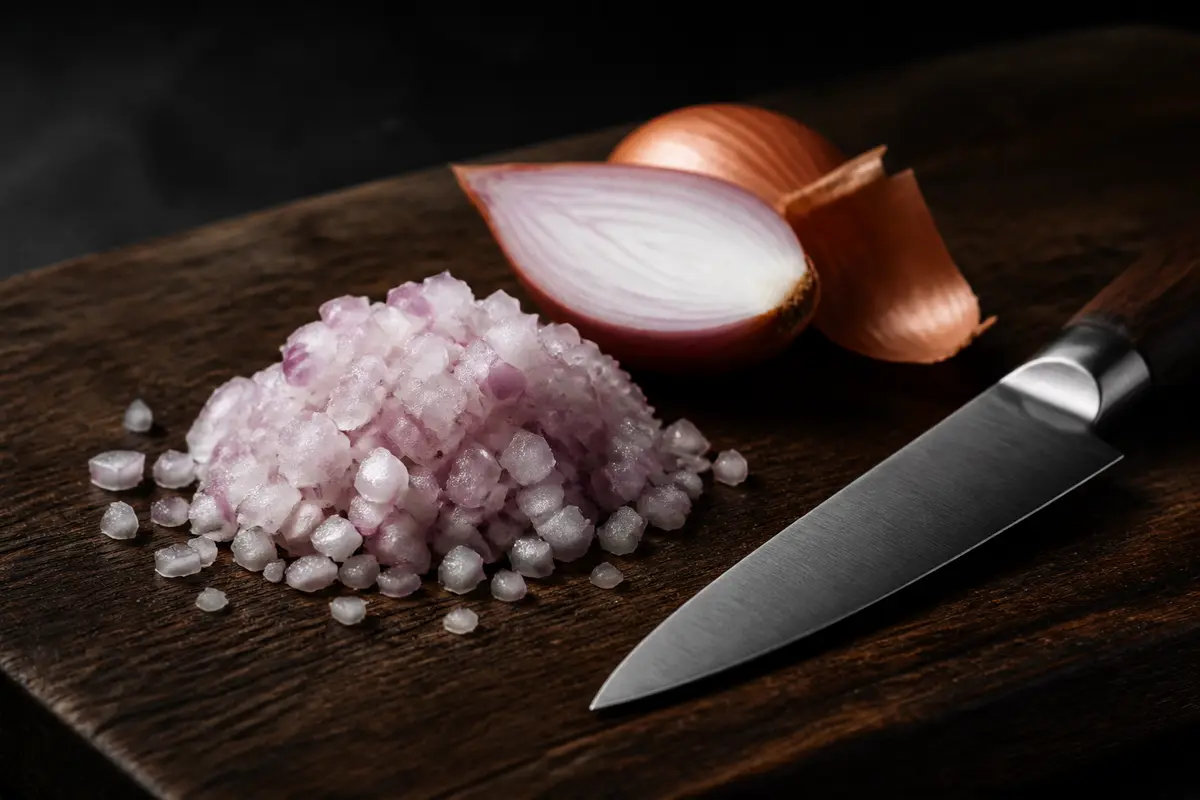
The petty is a Western-style knife made in Japan. A Tokyo Metropolitan Board of Education teaching document lists it, with the gyuto and the bread knife, among the knives that arrived with Western cooking from the Meiji era. The name probably comes from the French petit, “little” — that is how Josh Donald of Bernal Cutlery explains it to America’s Test Kitchen.
Japanese makers agree on the size. Kai gives a short blade of 120–150 mm and says the petty suits work in the hand and fine cutting; Tojiro gives the same range, calls it a popular second knife and recommends 120 mm for that role. Tojiro’s Classic line sells it at 120, 150 and 180 mm. Wikipedia widens the range to 10–18 cm, calls the petty the Japanese equivalent of a paring or utility knife, and says it is used for paring or for smaller produce, often alongside a gyuto.
The shape is a small chef’s knife rather than a pared-down peeler: ATK describes the petty blade as more triangular, with a straight rather than curved edge. That straight section is what lets it work on the board as well as in the hand.
The paring knife
Paring knife 90 mm 205 mm overall · F-800
Petty knife 120 mm 230 mm overall · F-801
Petty knife 150 mm 260 mm overall · F-802
Santoku (for scale) 170 mm 295 mm overall · F-503
Petty knife 180 mm 290 mm overall · F-798
The paring knife is the Western peeling knife. Wikipedia gives it a blade usually 6–10 cm (2–4 in) long, with no heel or choil, and calls it ideal for peeling — “paring” — fruit and vegetables and for other small or intricate work, such as deveining shellfish or removing the seeds from peppers. The bird’s beak or tourné knife, with a tip that curves down, is a specialised kind of paring knife.
Japanese makers treat it as a separate knife, too. Tojiro’s Classic line lists a 90 mm paring knife and a 70 mm peeling knife alongside — not instead of — its 120, 150 and 180 mm petty knives. Drawn to scale, the jump from the 90 mm paring knife to the 120 mm petty is about a third of the blade, and the 180 mm petty is already longer than the santoku next to it.
 Petty knife uses: in the hand and on the board
Paring 90 mm in the hand: the short blade stays close to the fruit, so the tip stays out of the way.
Peeling fruit, trimming and fine cuts — Kai’s description of the petty.
Wikipedia: paring and smaller produce, often alongside a gyuto.

Wikipedia’s paring list: peeling, deveining shellfish, seeding peppers.
The two halves of a petty’s work pull in opposite directions. In the hand, the blade works around a piece of fruit, and the paring knife — which Wikipedia calls ideal for peeling — keeps it short. On the board, a longer blade reaches through a lemon or across a pile of shallots. A 120 mm petty sits between the two, and that is the size Tojiro recommends as a second knife. If you only ever peel and core, the paring knife is the simpler tool.
Petty vs utility knife
One 150 mm knife
America’s Test Kitchen: both the petty and the utility knife are mid-size knives between a chef’s knife and a paring knife.
“Utility knife” is the Western name for the same size class. Wikipedia puts the kitchen utility knife between a chef’s knife and a paring knife, at roughly 10–18 cm — the same numbers it gives for the petty. America’s Test Kitchen explains the difference as one of profile and history: utility knives were traditionally narrow and fairly long, curving slightly from heel to tip, and were once used to clean and process game, while the petty is more triangular with a straight edge. It also notes that the lines have blurred over the years, and its advice is short: “Buy by function, not by name.”
 Petty vs santoku
Main knife santoku 165–180 mm (Kai) · drawn at 170 mm
Second knife petty 120 mm (Tojiro’s pick)
These two are not really alternatives. Kai sells the santoku as the all-purpose home knife at about 165–180 mm, for meat, fish and vegetables; the petty is the small knife you keep next to it. Tojiro describes the petty as a popular second knife and recommends the 120 mm size for that job. If you are still choosing the main knife, see santoku vs nakiri and gyuto vs santoku vs bunka.
Which one, and what size
- 1One small knife for everything
Petty, 120 mm — Tojiro’s recommended second knife.
- 2More board work
Petty, 150 mm — the top of Kai’s and Tojiro’s range, with more reach.
- 3Only peeling and coring
Paring knife, 6–10 cm (Tojiro’s is 90 mm).
- 4No main knife yet?
Start with a santoku or gyuto; add the petty second.
Both petty lengths are in the true-size tool of the knife size and handle guide, which also covers Japanese and Western handles. Steel matters as much on a small knife as a big one — compare in the Japanese knife steel chart — and the buying guide and import duty calculator cover ordering from Japan. For a long knife to go with it, compare the sujihiki and yanagiba; every shape is on the Japanese knife types page.
Breaking down poultry with a small knife? See honesuki vs garasuki vs hankotsu.
Frequently asked questions
- Is a petty knife the same as a paring knife?
- Not quite. Wikipedia calls the petty the Japanese equivalent of a paring or utility knife, but the usual sizes differ: Kai and Tojiro give 120–150 mm for a petty, while Wikipedia gives 6–10 cm for a paring knife. Tojiro itself sells a 90 mm paring knife separately from its 120, 150 and 180 mm petty knives.
- What is a petty knife used for?
- Kai says the petty suits work in the hand and fine cutting; Wikipedia adds paring and smaller produce, often alongside a gyuto. Tojiro recommends a 120 mm petty as a second knife next to an all-purpose knife.
- What size petty knife should I get?
- Kai and Tojiro both give 120–150 mm, and Tojiro recommends 120 mm as a second knife. Longer blades reach further on the board; Tojiro’s Classic line also has a 180 mm petty, which is the top of Wikipedia’s 10–18 cm range.
- What is the difference between a petty knife and a utility knife?
- Mostly the profile and the name. America’s Test Kitchen describes both as mid-size knives between a chef’s knife and a paring knife; the petty tends to be triangular with a straight edge, the utility knife narrower with a slight curve. Its advice is to buy by function, not by name.
Sources
- Kai: choosing a Western-style knife (petty 120–150 mm, for work in the hand and fine cuts; santoku 165–180 mm)
- Tojiro: knife sizes by type (petty 120–150 mm; 120 mm recommended as a second knife)
- Tojiro: Classic series line-up (peeling 70 mm, paring 90 mm, petty 120/150/180 mm, santoku 170 mm, with overall lengths)
- Wikipedia: Kitchen knife (paring knife 6–10 cm, uses, no heel or choil; bird’s beak; utility knife 10–18 cm)
- Wikipedia: Japanese kitchen knife (petty 10–18 cm; described as the Japanese equivalent of a paring or utility knife)
- America’s Test Kitchen: petty knives versus utility knives — what’s the difference (with Josh Donald of Bernal Cutlery)
- Tokyo Metropolitan Board of Education: teaching material on Japanese knives (petty among the Western knives from the Meiji era)
Checked 2026-11-02. We have not tested these knives ourselves. Lengths are the published figures of each source and are kept separate in the slider; outlines and the hand-and-board figure are illustrations.