Care & kitchen · sources checked 2026-11-02Cutting boards for
Japanese knives
Short answer: cut on something that gives a little. Tojiro recommends wood or rubber boards as relatively soft and kind to the edge, and Zwilling’s Japanese arm says a wooden board of good timber such as hinoki (Japanese cypress) has a moderate springiness that eases the load on the knife. Soft elastomer boards and end-grain or edge-grain hardwood also qualify. Avoid glass and stone, which are as hard as the edge or harder, or, like marble, simply do not give, and be wary of bamboo and very hard plastic. Measured tests disagree about which soft board is best, so choose by size and upkeep.
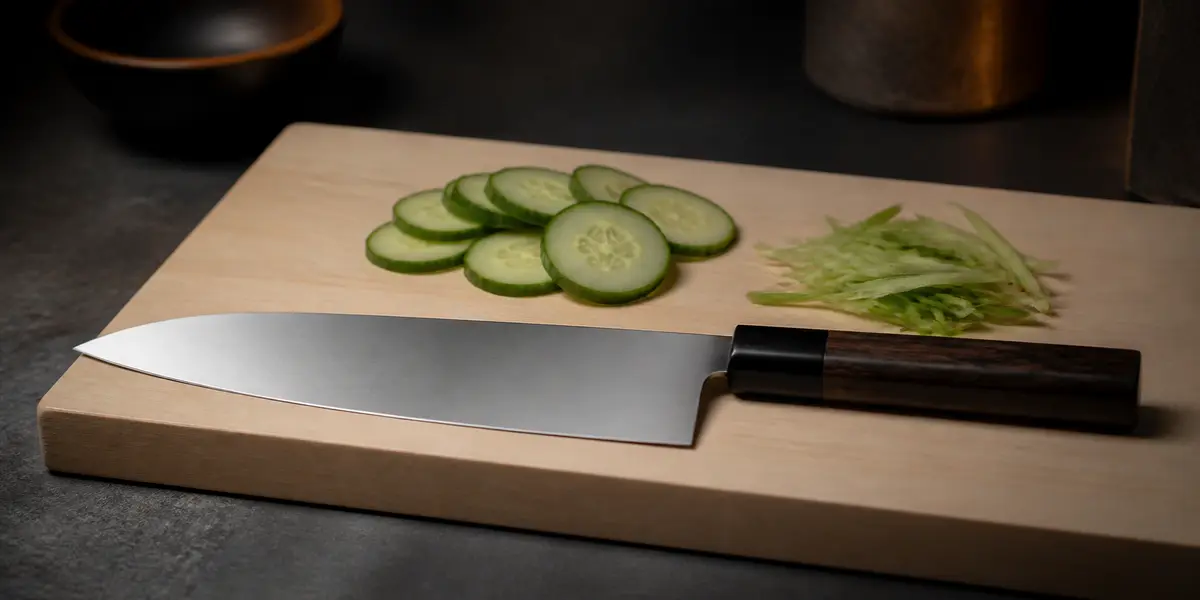
 What the board does to the edge, magnified
Most Japanese double-bevel knives are sharpened at about 15° per side (see the sharpening angle calculator), and hard Japanese steels are ground thin, so the apex is the most fragile part of the knife, and it meets the board on every cut. Pick a board to see what happens in the instant the edge lands.
Pick a board
Tempered glass Avoid
Illustration of the makers’ three groups, not a measured value.
| Surface hardness | Mohs 5–6 (soda-lime float glass) (Pilkington) |
|---|---|
| Against the edge | About as hard as the edge itself: a knife blade rates 5–6.5 on the same scale (geology.com). And glass does not give at all. |
| What happens to the edge | The apex lands on a surface it cannot cut into, so the thinnest part of the edge is flattened or rolled on every chop. Tojiro names glass and marble boards as a major cause of crushed edges. |
| Upkeep | Non-porous and easy to clean (USDA). |
| Hygiene note | In one lab study, Salmonella formed biofilm on glass less often (10% of strains) than on plastic (40%) or wood (60%) (Dantas et al. 2018). |
“Makers’ verdict” follows Tojiro and Zwilling Japan. The hardness figures use scales that cannot be converted into one another: Mohs ranks what scratches what, Janka is the force to press a steel ball into wood, Shore D is a plastics scale. Where no maker publishes a figure, we say so.
 The short list
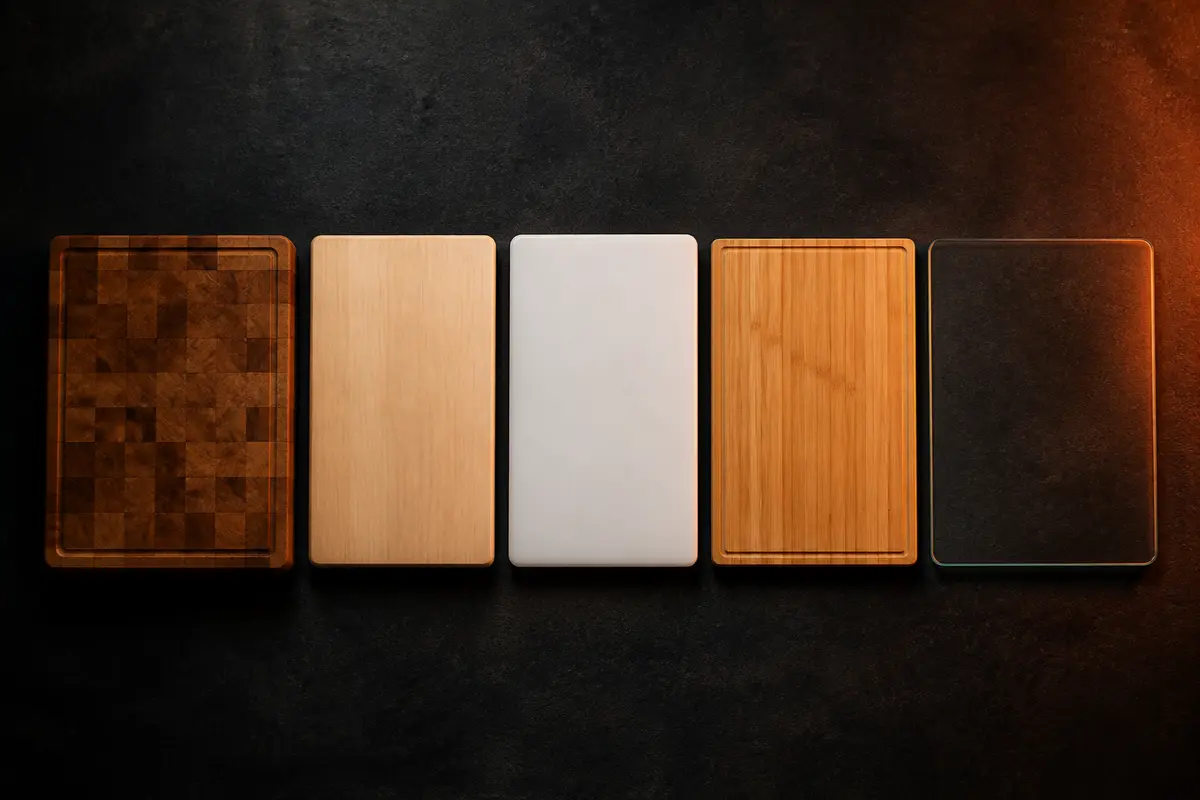
| Board and makers’ verdict | On the edge | Upkeep |
|---|---|---|
| Hinoki (Japanese cypress) Gentle | A good wooden board’s moderate springiness eases the load on the knife (Zwilling Japan) | Wet before use, dry standing up; no soaking. Zwilling Japan says no bleach; the USDA allows a dilute sanitizer |
| Synthetic rubber or soft elastomer Gentle | Soft and kind to the edge (Tojiro); TPU lets the blade sink in slightly (Zwilling Japan) | Non-porous; scrub and dry |
| End-grain hardwood Gentle | The edge meets the fibre ends; tests disagree on how much that helps | Heavy; dry standing up |
| Edge-grain hardwood Gentle | Wood is gentle on edges (Tojiro, Zwilling Japan) | Dry standing up; no soaking |
| Hard plastic (HDPE, polypropylene) Firm | Tojiro lists high-hardness plastic with glass and marble as a major cause of crushed edges | Often dishwasher-safe; replace when deeply scarred |
| Bamboo Firm | Very hard and can damage blades (Zwilling Japan) | As for wood |
| Glass, stone or metal Avoid | Crush or chip the apex (Tojiro; America’s Test Kitchen for metal) | Easy to clean |
If you only buy one board, make it a large wooden or rubber one: Tojiro and Zwilling’s Japanese arm class both as gentle, and the tests below found no consistent winner among soft boards. A nakiri, which chops straight down, puts the whole edge on the board with every stroke, so the surface matters even more. If you cut raw meat and fish often, a second non-porous board that can go in the dishwasher is a sensible partner.
 Why glass, stone and bamboo are hard on a thin edge
The Mohs scale ranks what scratches what. Pilkington rates ordinary soda-lime float glass at 5–6. Geology.com puts a knife blade at 5–6.5 and quartz, the mineral that makes granite hard, at 7. So a glass board is about as hard as the edge, and the quartz grains in granite are harder. Marble is mostly calcite (Mohs 3), softer than steel, but stone does not give, so the apex still stops dead. Tojiro names hard plastic, glass and marble boards as a major cause of crushed edges; the chipped knife guide shows what that damage looks like and how to grind it out.
Mohs: Pilkington (float glass), geology.com (knife blade, quartz, calcite). Janka: The Wood Database. Hinoki has no standard Janka figure that we could find; its specific gravity is 0.40–0.54 (Nakamura Tsukiita), against about 0.71 for hard maple. HDPE plastic (Shore D 65, SIMONA) is on a third scale and cannot be placed on either.
Bamboo is a grass, not a wood. The Wood Database lists it at 1,410–1,610 lbf on the Janka scale, against 1,450 lbf for hard maple and 1,010 lbf for black walnut, and notes 0.5–4% silica concentrated in the outer layers of the stem; tools dull quickly when turning it. Zwilling Japan’s guide says plainly that bamboo boards are very hard and can damage blades. Metal boards are worse still: when America’s Test Kitchen gave each of five titanium and stainless boards a fresh chef’s knife, every knife dulled dramatically, while the same knife on a wooden board stayed close to new.
 End grain vs edge grain
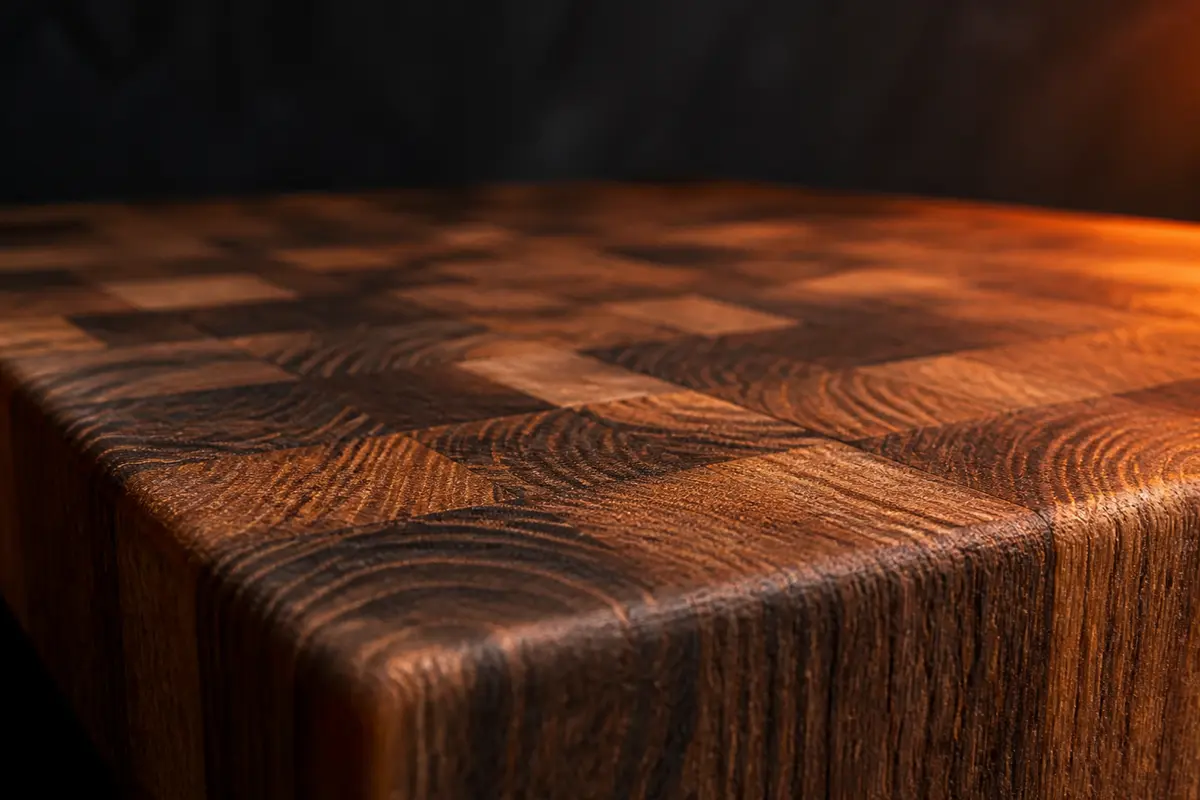
On an edge-grain board the fibres run along the board, so every cut severs a few of them. On an end-grain board the blocks are turned on end: the fibres stand upright and the edge meets their ends. The usual sales pitch is that the edge slips between the fibres and they close up again. Switch between the two below.
Two things complicate the pitch. First, wood is harder on its end face, not softer: in tests by the Okayama Prefectural Forest Research Institute, konara oak resisted a steel ball with 50.0 N/mm² on the end face against 21.7 N/mm² on the flat-sawn face, and the other five species showed the same pattern. Second, the edge-wear tests below did not find end grain consistently gentler. End-grain boards are heavy and stable, which many cooks like; whether they keep a knife sharper has not been shown.
 What edge-wear tests have actually measured
We found two kinds of published measurement. America’s Test Kitchen checked knives with an industrial sharpness tester before and after cutting on metal boards (above). Prudent Reviews ran two tests with a BESS sharpness tester, which records the grams of force a blade needs to cut a calibrated wire: higher means duller. Each board got one knife and 300 rocking cuts plus 300 straight chops. The bars show how much each knife dulled.
PlasticEnd grainEdge grainSoft elastomerComposite
Source: Prudent Reviews (two articles). Product names omitted; “board 1” and “board 2” are different makers’ boards of the same wood.
The two tests contradict each other. Polypropylene dulled the knife the most in the first and the least in the second. End-grain walnut was the gentlest board in the first; in the second, an end-grain teak board was the second-worst. Two edge-grain maple boards differed more than threefold. With one knife per board and different starting sharpness (181 to 454 g), the results are consistent with sample-to-sample noise. The clear result is the hard end of the scale: glass, stone and metal are a loss. Among wood, rubber and plastic, nobody we found has measured a difference large and consistent enough to say one keeps an edge sharp for weeks longer.
 Wood or plastic: what the hygiene studies say
Neither material wins every study. Wood draws liquid and bacteria into its pores; in some studies they were then hard to recover and died off, while in a food-service washing test bacteria came back on wood but not on plastic. Plastic keeps them on the surface, where washing can reach them until knife scars give them somewhere to hide.
Favours wood (3)Favours plastic (1)Favours non-porous (2)Against plastic (1)
- 1994University of Wisconsin (Ak, Cliver & Kaspar)Favours wood
Bacteria were recovered less often from nine hardwoods than from four plastics and hard rubber. Clean wood soaked up the liquid within 3–10 minutes; after 12 hours, numbers on wood were down by at least 98%. Knife-scarred plastic was hard to clean by hand. Mineral oil on the wood made little difference.
- 1997Cornell University (Welker et al.)Favours plastic
With commercial food-service washing, plastic surfaces came out consistently cleaner than wood, and bacteria reappeared after washing only on wood.
- 2006Review by Dean Cliver, a co-author of the 1994 studiesFavours wood
High-density polyethylene delaminates under knife scarring, and knife-scarred plastic is very difficult to clean and disinfect. Of two epidemiological studies he reviews, one indicated that plastic boards in home kitchens are hazardous and wooden boards are not.
- 2012Soares et al., BrazilFavours non-porous
Of wood, triclosan-treated plastic, glass and stainless steel, wood was the hardest to clean. Soap, scrubbing and a hypochlorite (bleach) rinse brought Salmonella below detection on every surface.
- 2018Dantas et al., Foodborne Pathogens and DiseaseFavours non-porous
Salmonella from raw chicken reached cucumbers via wood, plastic and glass boards. Of 10 strains, 60% formed biofilm on wood, 40% on plastic and 10% on glass; where biofilm formed, washing did not remove the bacteria.
- 2023Yadav et al., Environmental Science & TechnologyAgainst plastic
Chopping on polyethylene and polypropylene boards releases microplastics: on the authors’ assumptions, 7.4–50.7 g a year per person from polyethylene and 49.5 g from polypropylene.
- 2025Freie Universität Berlin (Bischoff et al.)Favours wood
On professional sugar-maple boards, E. coli fell to the detection limit within two hours, even without cleaning. HDPE boards had higher counts overall.
The USDA’s food-safety service accepts either wood or a non-porous board such as plastic, notes that non-porous surfaces are easier to clean, says to replace a board once it has hard-to-clean grooves, and suggests keeping a board for produce and bread separate from one for raw meat. Wash every board with hot, soapy water after use and let it dry completely. To sanitize, the USDA says both wooden and plastic boards can be treated with a solution of 1 tablespoon of unscented liquid chlorine bleach per gallon of water. Zwilling Japan, by contrast, advises against bleach on wooden boards, so on a hinoki board the two sources disagree.
 How to look after a hinoki board
Zwilling Japan’s care steps for wooden boards, with the USDA’s advice on raw meat:
- 1Wet it first
Wipe the surface with water before you cut, so juices and smells soak in less.
- 2
 Keep raw meat apart
Use a separate board for raw meat and fish, or wash straight after them. Zwilling Japan suggests plastic for this because it can be bleached.
- 3Wash promptly
Wash it right after use; scrub with salt or baking soda and a brush, then rinse.
- 4No soaking or boiling water
Both can warp and crack the board. Zwilling Japan also advises no bleach on wood; the USDA allows a dilute sanitizer (see above).
- 5Dry it standing up
On edge, in a shaded, airy place. Moisture left in the wood causes black stains and mould.
Is hinoki antibacterial? Zwilling Japan says hinoki may be. The compound usually credited, hinokitiol, is named after Taiwan hinoki, where it makes up about 0.1–0.2% of the wood; Japanese hinoki has about 0.02% (figures reported on Wikipedia, citing Hu et al. 2013; the paper’s abstract does not give them, and we have not seen the full text). We found no study of bacteria on hinoki cutting boards, so we would not rely on it. Zwilling Japan’s steps do not include oiling a hinoki board, and in the Wisconsin study mineral oil on the wood made little difference to bacteria.
The board is half of keeping an edge. The other half is in our Japanese knife care guide (washing, rust and storage) and the whetstone grit chart for when the edge does go dull. Harder steels hold a thin edge longer but chip more easily; compare them in the Japanese knife steel chart or read Japanese vs German knives.
Frequently asked questions
- What is the best cutting board for Japanese knives?
- One that gives a little under the edge. Tojiro recommends wood or rubber as relatively soft boards that do little damage to the edge, and Zwilling’s Japanese arm says a wooden board of good timber such as hinoki has a moderate springiness that eases the load on the knife. Hinoki, synthetic rubber, soft elastomer boards and end-grain or edge-grain hardwood all fit. Avoid glass and stone, and be wary of bamboo and very hard plastic. Published tests disagree on which soft board is best, so choose by size and upkeep.
- Are glass cutting boards bad for knives?
- Yes. Soda-lime float glass rates 5–6 on the Mohs scratch-hardness scale (Pilkington), about the same as a knife blade (5–6.5, geology.com), and it does not give at all, so the thin apex is flattened or chipped on every chop. Tojiro names glass and marble boards as a major cause of crushed edges.
- Is bamboo bad for Japanese knives?
- It can be. Zwilling’s Japanese arm says bamboo boards look like wood but are very hard and can damage blades. The Wood Database lists bamboo at 1,410–1,610 lbf on the Janka scale, close to hard maple’s 1,450 lbf, but notes 0.5–4% silica, a mineral, concentrated in the outer layers of the stem, and that tools dull quickly when turning it.
- Is wood or plastic better for knives?
- Tojiro prefers wood or rubber to hard plastic, and Zwilling’s Japanese arm calls plastic hard on blades, but measured tests disagree. In one sharpness-tester test a polypropylene board dulled the knife the most of five boards; in another it dulled the knife the least of nine. For hygiene, studies also split, and the USDA accepts both: clean the board promptly and replace it once deep grooves are hard to clean.
Sources
- Tojiro: keeping the edge sharp for longer (wood and rubber boards are gentle; avoid hard plastic, glass and marble)
- Zwilling Japan: how to choose a cutting board (plastic, hinoki, TPU, rubber, bamboo, glass and stone; caring for wood)
- The Wood Database: hard maple (Janka 1,450 lbf; 705 kg/m³)
- The Wood Database: black walnut (Janka 1,010 lbf)
- The Wood Database: bamboo (Janka 1,410–1,610 lbf; 0.5–4% silica; tools dull quickly)
- Nakamura Tsukiita: Japanese woods — hinoki (specific gravity 0.40–0.54)
- Okayama Prefectural Forest Research Institute, Bulletin 40 (2026): basic wood properties of local hardwoods (end-face and flat-face Brinell hardness)
- Pilkington: Technical Bulletin ATS-129, properties of soda-lime silica float glass (Mohs 5–6)
- Geology.com: Mohs hardness scale (knife blade 5–6.5, quartz 7, calcite 3)
- SIMONA America: HDPE technical data sheet (Shore D 65, ASTM D2240)
- America’s Test Kitchen: metal cutting boards (knives dulled on every metal board; sharpness tester)
- Prudent Reviews: wood vs plastic cutting boards (BESS dulling test, five boards)
- Prudent Reviews: best cutting boards (BESS dulling test, nine boards; updated 2025-11-05)
- Ak, Cliver & Kaspar (1994). Cutting boards of plastic and wood contaminated experimentally with bacteria. J Food Prot 57:16–22
- Ak, Cliver & Kaspar (1994). Decontamination of plastic and wooden cutting boards for kitchen use. J Food Prot 57:23–30
- Welker et al. (1997). Bacterial retention and cleanability of plastic and wood cutting boards with commercial food service maintenance practices. J Food Prot 60:407–413
- Cliver (2006). Cutting boards in Salmonella cross-contamination. J AOAC Int (PubMed)
- Soares et al. (2012). Transfer of Salmonella Enteritidis to four types of surfaces after cleaning procedures. Food Microbiology
- Dantas et al. (2018; online 2017). Cross-contamination and biofilm formation by Salmonella Enteritidis on various cutting boards. Foodborne Pathog Dis 15(2):81–85
- Yadav et al. (2023). Cutting boards: an overlooked source of microplastics in human food? Environ Sci Technol
- Bischoff et al. (2025). Hygienic evaluation of wooden cutting boards: microbiological parameters. J Food Prot
- USDA FSIS: Cutting boards and food safety (archived fact sheet: wood or non-porous boards, separate boards, sanitizing with 1 tablespoon of unscented liquid chlorine bleach per gallon of water)
- Wikipedia: Hinokitiol (concentration in Japanese and Taiwan hinoki, citing Hu et al. 2013)
- Hu et al. (2013). Application of hinokitiol potassium salt for wood preservative. J Environ Sci (China) 25 Suppl 1:S32–S35 (cited by Wikipedia for the concentrations)
Checked 2026-11-02. We have not tested these boards ourselves; the edge-wear figures are other people’s published measurements, and the magnified diagrams are illustrations. Found a better source or an error? Tell us.