Knife shapes · sources checked 2026-11-02Sujihiki vs yanagiba
(and takohiki)
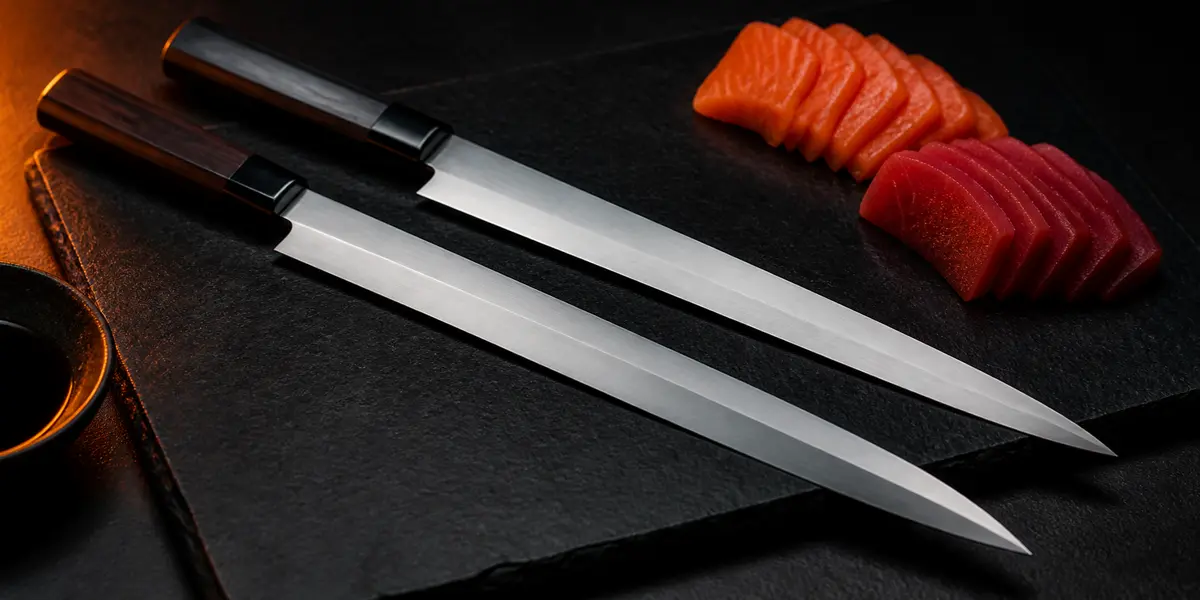
Short answer: a yanagiba is the traditional Japanese sashimi knife — single-bevel, long and narrow, with a pointed tip, usually 27–33 cm. A takohiki is the Tokyo (Kanto) version of the same idea, with a square tip and a lower, thinner blade. A sujihiki is a Western-style, double-bevel slicer of about 24–30 cm, made for meat and also used on fish. For sashimi and sushi cut the traditional way, look at the yanagiba; for roasts and the occasional sashimi, or one slicer that works in either hand, look at the sujihiki.
All three knives on this page are long and narrow. Laid over each other at the same scale, the differences show at the tip and in the cross-section. Tap a knife to see it on its own.
Dashed outline: a 210 mm gyuto, for scale
Three long, narrow slicers at the same 270 mm length. The yanagiba and takohiki are traditional single-bevel sashimi knives; the sujihiki is a double-bevel Western-style slicer. Tap one to see its tip, bevel and where it comes from.
Yanagiba 柳刃
- Bevel
- Single (kataba) — Kai, Kotobank
- Tip
- Pointed
- Region
- Kansai (Osaka) style — Sakai Hamono association
- Length
- Kai: 180 mm and up; Wikipedia: usually 27–33 cm
Takohiki 蛸引
- Bevel
- Single — Kotobank defines sashimi knives, takohiki included, as single-bevel
- Tip
- Square; spine and edge run parallel (Kotobank, Kai)
- Region
- Kanto (Tokyo) style
- Height
- Lower, thinner and lighter than a yanagiba (Wikipedia)
Sujihiki 筋引
- Bevel
- Double (Wikipedia); sold as a Western-style knife in Tojiro’s Classic line and Kai’s Western-knife guide
- Tip
- Pointed
- Origin
- Name means “muscle/sinew puller”; long knife for meat (Wikipedia)
- Length
- Tojiro Classic: 240 and 270 mm; Wikipedia: 24–30 cm
 At a glance
| Sujihiki | Yanagiba | Takohiki | |
|---|---|---|---|
| Japanese name | 筋引 (sujihiki) | 柳刃 (yanagiba) | 蛸引 (takohiki) |
| Family | Western-style knife (Tojiro, Kai) | Japanese sashimi knife | Japanese sashimi knife |
| Bevel | Double | Single | Single |
| Tip | Pointed | Pointed | Square — spine and edge run parallel |
| Usual length | 24–30 cm (Wikipedia); Tojiro Classic 240 and 270 mm | 27–33 cm (Wikipedia); Kai: 180 mm and up | No standard found; a regional variant of the yanagiba |
| Region | — | Kansai (Osaka) | Kanto (Tokyo) |
| Made for | Slicing meat, often with a draw cut | Sashimi; skinning fish | Sashimi; dense flesh such as octopus |
| Left-handed cooks | Usually the same knife | Need a left-handed version | Need a left-handed version |
From Kai, the Kotobank dictionaries, the Sakai Hamono association, Tojiro and Wikipedia. Left-handed: a single-bevel knife is made for one hand — see single-bevel vs double-bevel.
Yanagiba: the sashimi specialist from Kansai.

Takohiki: the Kanto (Tokyo) sashimi knife.
Sujihiki: a Western-style slicer for meat and fish, either hand.
The yanagiba: Kansai’s sashimi knife
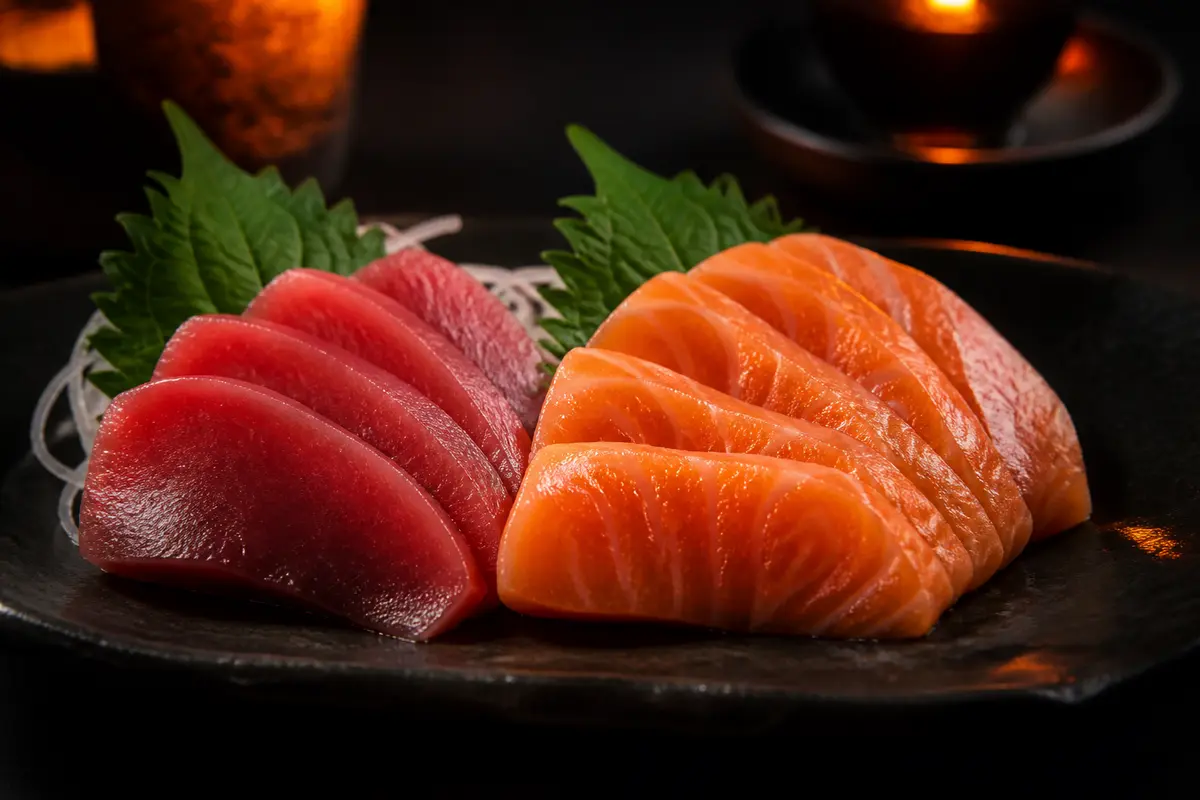
Yanagi-ba means “willow blade”. The Sakai Hamono association, the cutlers’ cooperative in Sakai, explains that the yanagiba was originally the Kansai-style sashimi knife, and that it is also called shōbu, a name it links to the long, pointed shape of willow or iris leaves. Wikipedia calls it the most popular knife for cutting fish, and lists skinning fish among its jobs.
What makes it a sashimi knife is the combination of a single bevel and length. Kai describes the sashimi knife as single-bevel, with a blade of 180 mm or more, and credits the single bevel with the especially clean cut face that these knives are known for. A Japanese dictionary of kitchen tools (Kodansha) explains the length: to keep the cut face smooth, the slice is pulled without going back and forth, so the blade is long and the width narrow. Wikipedia gives 27–33 cm as the usual range.
The single bevel is also the catch. It is ground for one hand, the back is hollow, and sharpening it is a different job from sharpening a gyuto — the geometry is laid out in single-bevel vs double-bevel knives, and the angles in the sharpening angle calculator.
 The takohiki: Tokyo’s square-tipped version
- Kansai (Osaka) — yanagiba, pointed tip
- Kanto (Tokyo) — takohiki, square tip
- Coastline: Natural Earth
The takohiki is the eastern answer to the same problem. The Kodansha dictionary describes it as a sashimi knife whose spine and edge run parallel, with the heel and the tip the same width, so the whole blade is a long rectangle; it says the yanagiba was used mainly in Kansai and the takohiki in Kanto, but that in recent years the yanagiba has become the more common one. The Heibonsha encyclopedia puts it more simply: a sashimi knife with a point is a yanagiba, one without is a takohiki. Kai also calls the takohiki the Kanto-style sashimi knife with a square tip.
Wikipedia adds that the takohiki is lighter, thinner and flatter than the yanagiba, with a lower blade, and that the “octopus cutter”, as the name translates, is shaped to cut dense flesh such as octopus more easily. A third sashimi knife, the fuguhiki, is narrower still: Kai says it has a narrower blade and a thinner spine than a standard sashimi knife, for the very thin slices of fugu.
- Takohiki vs yanagiba: the same single-bevel, pull-cut sashimi knife; the takohiki has a square tip and a lower, lighter blade. Choose by the tip you prefer and the regional style you are learning.
- Takohiki vs sujihiki: everything that separates the yanagiba from the sujihiki — single vs double bevel, wa vs Western style — plus a square tip instead of a point.
The sujihiki: a double-bevel slicer for meat and fish
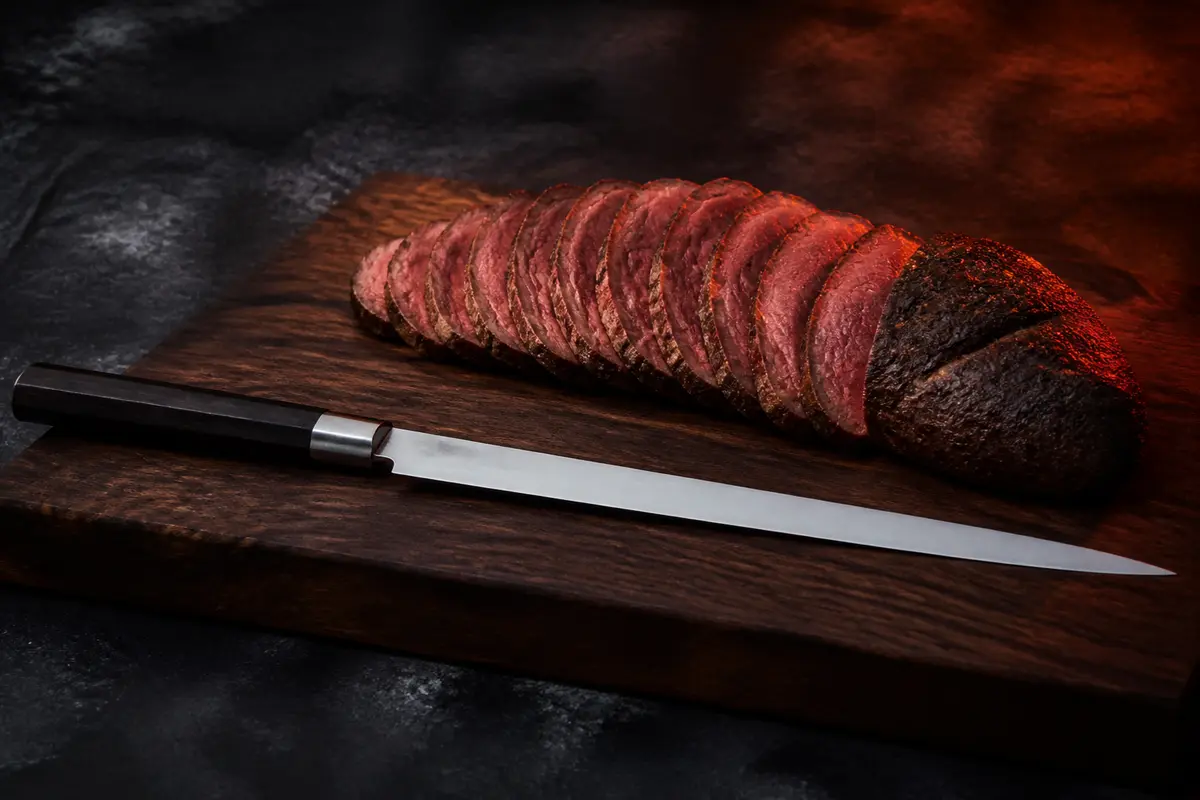
Japanese makers sell the sujihiki as a Western-style knife. Tojiro’s Classic line, which has Western handles, lists it at 240 mm and 270 mm — about 365 mm and 395 mm overall — and Kai’s guide to Western-style knives describes a slicer for meat and fish whose blade is long, thin and flexible so it can slice very thinly. Wikipedia lists the sujihiki as double-bevel, translates the name as “muscle/sinew puller”, likens it roughly to a Western carving knife, and describes it as a long knife for cutting meat, often with a draw cut, usually 24–30 cm.
Because it is double-bevel, a sujihiki behaves like a long, narrow gyuto: it works the same in either hand, it is sharpened like any other double-bevel knife, and it does not steer the way a single-bevel blade does. That makes it a straightforward knife for carving a roast — Wikipedia’s description is a long knife for meat — and it still slices fish with a long pull. What it does not have is the single bevel that Kai credits with the sashimi knife’s clean cut face. We found no controlled test comparing sashimi cut with each.
 One long pull: why slicers are so long
Every knife on this page is long for the same reason. The Kodansha dictionary says a sashimi slice is pulled without going back and forth, and that this is why the blade is long. Cutting research points the same way: in experiments on cheese and salami, Atkins and colleagues showed why it is easier to cut by pressing and sliding than by pressing down alone, and a later paper by Atkins links motion along the blade to lower cutting forces and less damage to the cut surface. A long blade gives you a lot of slide for each millimetre of depth in a single stroke.
10.8 mm of edge per 1 mm of depth
Yanagiba 270 mm through a 25 mm block in one pull: about 10.8 mm of edge passes through the fish for every 1 mm the blade sinks, and each part of the edge goes through once — heel first, tip last.
Switch to the petty or the gyuto and the triangle gets steeper: there is less edge to pull through the same block, so either the stroke is steeper or you end up going back and forth — exactly what the sashimi knife is shaped to avoid. Switch to “saw” to see the same short stretch of edge working the fish again and again.
 For sashimi, sushi or roasts: which one to buy
- 1Sashimi and sushi, the traditional way
Yanagiba. Wikipedia’s usual range is 27–33 cm.
- 2Roasts and meat, some fish
Sujihiki, 240 or 270 mm — double-bevel and easy to sharpen.
- 3
 Left-handed?
Sujihiki, or a left-handed yanagiba — single-bevel knives are made for one hand.
- 4Want the Tokyo style?
Takohiki: square tip, lower and lighter blade.
Length matters on the board. A 270 mm slicer with a Western handle is about 395 mm overall (Tojiro Classic F-806). The true-size tool in the knife size and handle guide has no slicers, but its 270 mm gyuto (about 405 mm overall) is close enough to check against your board. Then choose the steel in the Japanese knife steel chart (or compare Blue and White steel) and see how to care for a Japanese knife.
Most people buy a slicer after an all-purpose knife. If you are still choosing that, compare santoku vs nakiri or gyuto vs santoku vs bunka; for small work in the hand, see petty vs paring knife. Every shape is on the Japanese knife types page, and the buying guide covers ordering from Japan.
For the Japanese boning knives, see honesuki vs garasuki vs hankotsu.
Frequently asked questions
- Can you use a sujihiki for sashimi?
- Yes. A sujihiki is long and narrow and slices with a pulling stroke, as a yanagiba does. The difference is the bevel: the sujihiki is double-bevel, while the yanagiba is single-bevel, and Kai credits the single bevel with the especially clean cut face that sashimi knives are valued for.
- Is a yanagiba or a sujihiki better for sushi?
- For slicing fish for nigiri and sashimi, the yanagiba is the traditional tool — Wikipedia calls it the most popular knife for cutting fish. A sujihiki is the double-bevel alternative: it also handles roasts and other meat, and the same knife works in either hand.
- What is the difference between a takohiki and a yanagiba?
- Both are single-bevel sashimi knives. The yanagiba has a pointed tip and is the Kansai (Osaka) style; the takohiki has a square tip, with the spine and edge running parallel, and is the Kanto (Tokyo) style. A Japanese dictionary of kitchen tools notes that the yanagiba has become the more common of the two.
- What length yanagiba should I buy?
- Kai puts sashimi knives at 180 mm and up, and Wikipedia gives 27–33 cm as the usual range. They are long because a slice is pulled in one stroke without going back and forth. Check your board too: Tojiro’s 270 mm Western-handled sujihiki is about 395 mm overall.
Sources
- Kai: choosing a Japanese-style knife (sashimi/yanagiba: single-bevel, 180 mm and up; takohiki: Kanto style, square tip; fuguhiki)
- Kai: choosing a Western-style knife (slicer for meat and fish: long, thin and flexible)
- Kotobank: 刺し身包丁 (Kodansha dictionary of tableware and kitchen tools: pulled without going back and forth, so long and narrow; yanagiba in Kansai, takohiki in Kanto; Heibonsha World Encyclopedia)
- Kotobank: 刺身包丁 (Digital Daijisen: a long, narrow, single-bevel knife)
- Sakai Hamono association: Q&A (yanagiba as the Kansai-style sashimi knife, also called shōbu)
- Wikipedia: Japanese kitchen knife (suji-hiki, yanagi-ba, tako-hiki, fugu-hiki; lengths)
- Tojiro: Classic series line-up (sujihiki 240 mm F-805 and 270 mm F-806, about 365 and 395 mm overall)
- Atkins, Xu & Jeronimidis (2004), Cutting, by “pressing and slicing,” of thin floppy slices of materials illustrated by experiments on cheddar cheese and salami, J. Materials Science 39: 2761–2766
- Atkins (2016), Slice–push, formation of grooves and the scale effect in cutting, Interface Focus 6: 20160019 (PubMed)
Checked 2026-11-02. We have not tested these knives ourselves. The outlines, the cross-sections and the pull-stroke figure are illustrations built from how makers and reference works describe the shapes; “edge per millimetre of depth” is a simple guide, not a measured threshold.