Tool · sources checked 2026-11-02How to flatten a whetstone
— and how long to soak it
Quick answer: every knife you sharpen wears a dip into the middle of the stone (Kai), so Shapton, Kai and Tojiro say to flatten before or after every session. Draw a pencil grid on the wet stone, rub it on a diamond plate or flattening stone — forward, back and diagonally — until every line is gone, then chamfer the edges. Soaking depends on the stone: splash-and-go stones such as Shapton’s only need water on top (and never more than 30 minutes in water), while soaking stones go in until the bubbles stop — about 5 minutes by Tojiro’s guide, 10–20 by Kai’s.
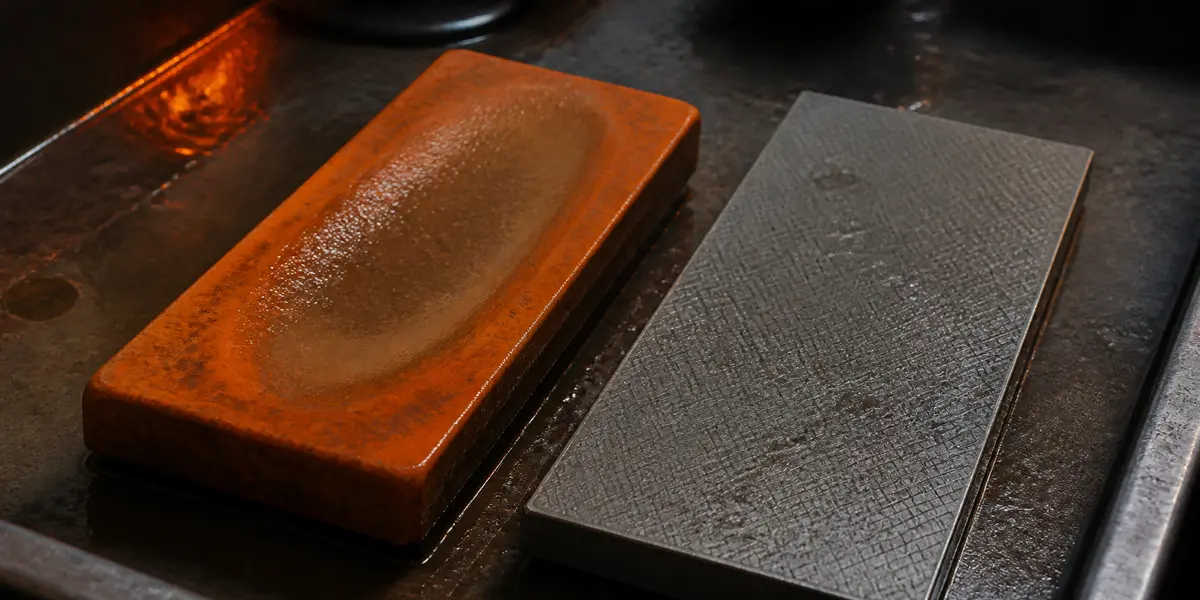
 Flattening lab: watch the pencil grid disappear
Set how many times the stone has been used since it was last flattened, then rub it flat. The ends and corners are the high spots, so their pencil lines vanish first; the last lines to go sit in the bottom of the dish. The side view shows how much stone you grind away to get there, and the small drawing shows the edge that stone would give you.
78% of the lines left. The ends and corners clear first because they are the high spots; the dished middle has not been touched yet.
- Pencil line still there = low spot, not touched yet
- Lighter orange = fresh surface the plate has reached
- Dark shading = depth of the dish
The pencil-grid check and the stroke pattern are Shapton’s. The rounded edge from a dished stone is Kai’s warning (it calls it maru-ba). Depth and strokes are illustrative: no maker we checked gives a depth in millimetres at which to flatten — they simply say to do it every time.
 Soak or splash-and-go? Whetstone soaking chart
Water stones come in two kinds. Soaking stones are porous and need to be full of water before you start; splash-and-go stones are denser and only need water on the surface. Soaking a splash-and-go stone does not help and can harm some of them. Filter the chart to your type:
Showing all 11 stones
- Shapton Kuromaku (Pro), Glass Stone, RockstarSplash with water
No soaking needed; 5–6 min only before the very first use. Never over 30 min (it can soften the stone), never hot water. Maker
- Naniwa Super Stone (Japanese line)Splash with water
Wet the surface and start; no soaking. Maker
- Naniwa Chosera / Professional (export)Splash with water
Splash-and-go according to a US retailer; let it dry fully before storing. Retailer
- Suehiro Debado (non-absorbing stones)Splash with water
Pour on a little water and sharpen; the maker calls them non-absorbing. Maker
- Tojiro Whetstones in general
Soak until bubbles stop, about 5 min. Maker
- Naniwa kirelu
Water-absorbing type: soak 5–10 min. Maker
- Suehiro Cerax #320 / #1000
Soak 5–10 min according to a US retailer, which says the #6000 is not soaked; dry before storing. Retailer
- Naniwa BASE
Soak about 10 min before use. Maker
- Kai Synthetic stones in general
Soak until bubbles stop, roughly 10–20 min. Natural stones barely absorb water and need no soaking. Follow your stone’s own instructions first. Maker
- Korin Mizuyama #1000 (Korin’s own brand)
At least 15 min. On a combination stone soak only the #1000 side; do not soak #3000+ finishing stones (they can crack). Dry before boxing to avoid mold. Maker
- King Deluxe #1000
Until bubbles stop, according to a retailer (we could not find King’s own instructions online). Dry completely before putting it back in the box. Retailer
Bars: soaking time each source gives (a fading bar means “at least”). A dashed box means the source gives no time, only “until bubbles stop”. The red line is Shapton’s 30-minute limit for its own stones. “Maker” links go to the stone maker’s own page; “Retailer” means we could only find a shop’s instructions.
How long to soak a whetstone — and can you overdo it?
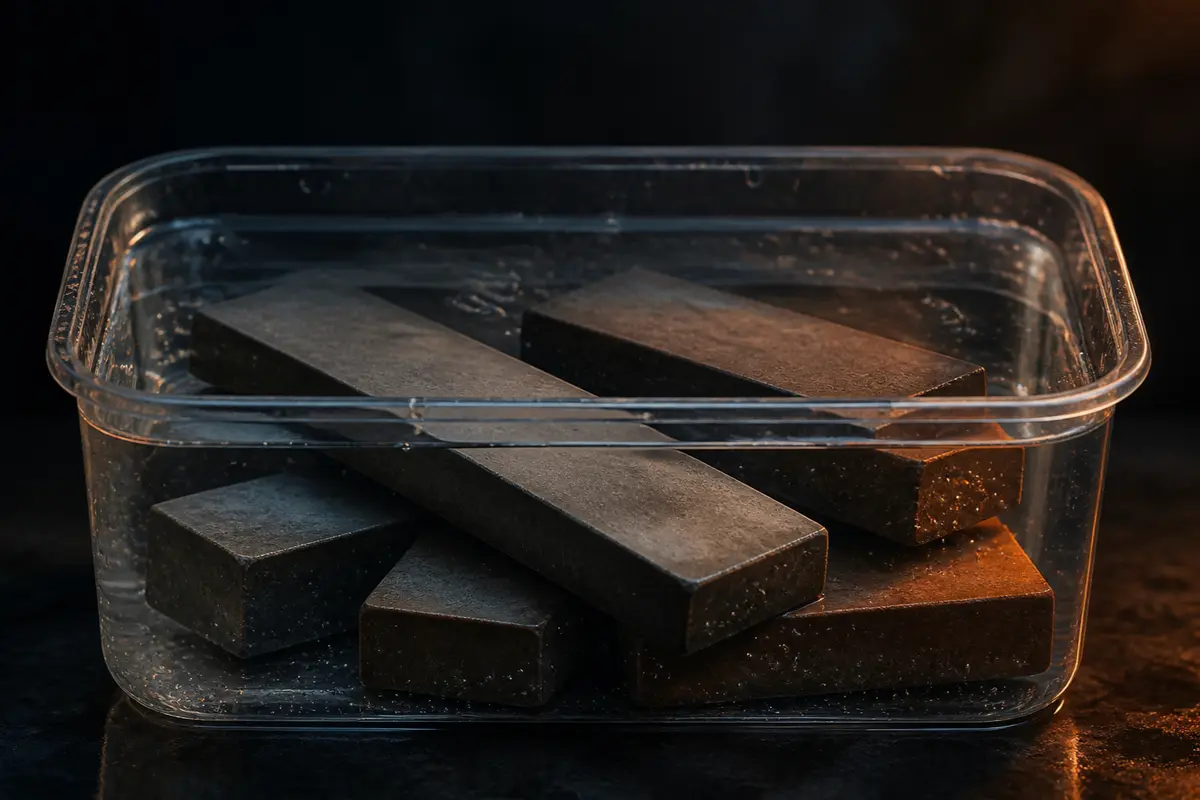
- The bubble rule. Kai and Tojiro both say to leave a soaking stone in water until bubbles stop coming out — about 5 minutes in Tojiro’s guide, roughly 10–20 in Kai’s. Kai adds that natural stones barely absorb water and need no soaking, and that your stone’s own instructions come first.
- Too long. Shapton is the one maker we found that sets a limit: never more than 30 minutes, because its stones can soften. Do not use hot water either; Shapton says the temperature change can crack a stone.
- Overnight. Apart from Shapton’s limit, none of the makers we checked says whether a soaking stone can stay in water overnight or be stored in water. Without that, we would not do it — follow the box.
- Combination stones. Korin tells owners of its #1000/finishing combination stones to soak only the #1000 side; its #3000 and finer finishing stones are not soaked at all, because they can crack.
- Drying and storage. Let a soaked stone dry before it goes back in its box, or it can grow mold (Korin; retailers say the same for King). Shapton says to store stones indoors at room temperature, away from direct sun.
 How often to flatten a whetstone
| Maker | How often they say to flatten |
|---|---|
| Shapton | Before every sharpening session |
| Kai | Every knife you sharpen leaves the stone dished, so correct it each time |
| Tojiro | Ideally after every use. Sharpening carbon-steel (hagane) knives on a softer stone wears its surface faster, so flatten often |
| Naniwa | After use, with a flattening stone |
| Suehiro | Keep the stone flat at all times with a correcting stone |
The reason is the edge. Naniwa says a dished stone will not give a keen edge; Tojiro says a stone worn in one spot distorts the edge; Kai says an uneven stone gives a rounded edge (maru-ba) and keeps your angle from staying steady. On a dip, the blade rocks as you move it, so the angle changes along each stroke:
Flat stone: one angle
flat bevel, crisp apex
Dished stone: the angle drifts
rounded bevel (maru-ba)
 How to flatten a whetstone, step by step
- 1Wet both surfaces
Soak or splash the stone as its maker says (chart above). Naniwa soaks its flattening stone with the stone for about 10 minutes; Shapton just wets its plate.
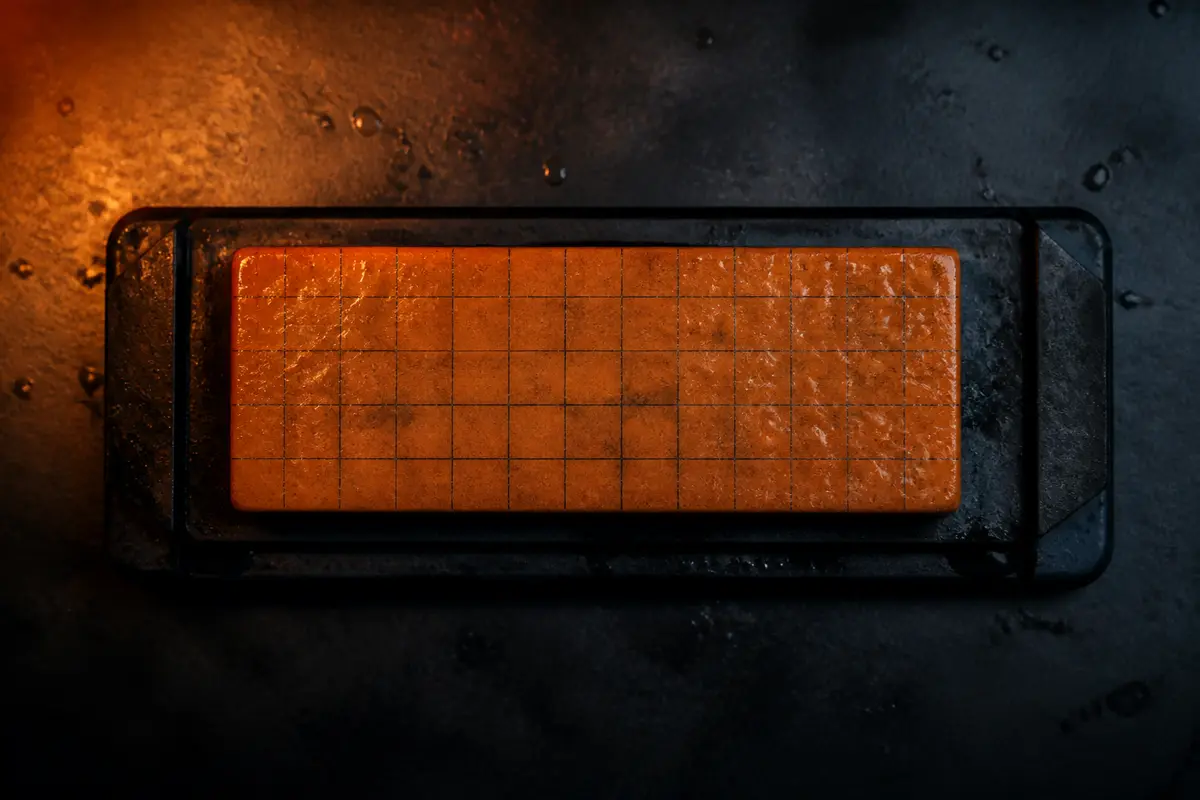
- 2Draw a pencil grid
Cover the whole face with a grid of pencil lines. They show where the plate has touched.
- 3Rub on the whole plate
Forward and back, then diagonally, over the plate’s whole surface. Shapton turns the stone 180° and repeats.
- 4Stop at the last line
When every pencil line is gone, the face is flat. Lines that survive mark the low spots.
- 5
 Chamfer the edges
Bevel the sharp edges of the stone slightly. Shapton’s instructions end with this step after every flattening.
- 6Rinse and dry
Rinse slurry off the stone and the plate, brush the plate’s grooves, and let the stone dry before boxing it.
Shapton’s instructions for its plates are exactly this: soak (2–3 minutes for its own stones; let other makers’ stones absorb plenty of water), draw the grid, wet the plate, move the stone forward and back and then diagonally over the whole plate, and rinse off the slurry when it builds up in the grooves. Kai uses a different check: fine steel dust collects in the dip and colours it, so flatten until that colour has gone. If you flatten a finishing stone on a coarse flattening stone, Naniwa says it may be left with fine scratches; rub them out with a stone of similar grit.
Diamond plate, flattening stone, sandpaper or another stone?
The right tool depends partly on the grit of the stone you are flattening. Shapton, which makes several kinds of flattening plate, draws the lines like this:
| Method | For | What the source says | Source |
|---|---|---|---|
| Diamond lapping plate | Fine stones, about #500 and up | Shapton’s DGLP is for 30 µm-class (#500) and finer, lasts roughly 1,000–3,000 uses, and is not for electroplated diamond stones. | Shapton |
| Rub two stones together | Coarse stones, #320 and below | Shapton recommends this (tomozuri) for #320 and coarser instead of its diamond plate, which coarse stones wear out quickly. | Shapton |
| Flattening stone | Most stones | Naniwa’s are #24, #60 and #220. A coarse one can leave fine scratches on a finishing stone; rub those out with a stone of similar grit. | Naniwa |
| Loose silicon-carbide powder on a flat plate | Any grit, matched to the powder | Shapton’s NAORU: coarse powder for #320 and below, medium for #500–#3000, fine for #4000 and up; wash between grades. | Shapton |
| Sandpaper on a flat surface | Workaround | Mentioned as an option in general references, but we found no stone maker’s instructions for it. The surface under the paper must itself be truly flat. | Wikipedia |
| Concrete block or sidewalk | Makers disagree | Tojiro says a flat concrete block wall will do if you have no correcting stone; Kai says asphalt and concrete roughen the stone’s surface. | Tojiro, Kai |
A diamond plate is popular because it stays flat itself: Wikipedia’s summary notes that diamond plates are used to keep water stones flat and wear very little in the process. Shapton still says not to use its diamond plates on electroplated diamond stones, which they can damage. Whatever you use, keep it wet and use its whole surface so it wears evenly too.
Once the stone is flat, follow how to sharpen a Japanese knife step by step. The whetstone grit chart explains what each grit does and how to step between them, and the sharpening angle calculator turns 15° into a spine height for your blade. A flat stone also matters when you repair a chipped edge on a coarse stone. For touch-ups between sessions, see honing rods for Japanese knives, and for washing and storage, the knife care guide.
Frequently asked questions
- How do you flatten a whetstone without a flattening stone?
- Rub it against another stone (Shapton recommends this for stones of #320 and coarser), or use loose silicon-carbide powder on a flat plate, which is how Shapton’s NAORU works. Sandpaper on a truly flat surface is a common workaround, though we found no stone maker’s instructions for it. Makers disagree about concrete: Tojiro says a flat concrete block wall will do in a pinch, while Kai says asphalt and concrete roughen the stone’s surface.
- How long should you soak a whetstone?
- It depends on the stone. Soaking stones are left in water until the bubbles stop: Tojiro says about 5 minutes, Kai roughly 10–20 minutes, Naniwa about 10 minutes for its BASE stone and Korin at least 15 for its #1000. Splash-and-go stones such as Shapton’s and Naniwa’s Super Stone only need water on the surface. Always check your own stone’s instructions first.
- Can you soak a whetstone too long or overnight?
- For some stones, yes. Shapton says never to soak its stones for more than 30 minutes because they can soften, and never to use hot water. Korin warns that its #3000 and finer finishing stones can crack if soaked. Most makers we checked do not say whether their soaking stones can be left in water overnight, so follow the box and let the stone dry before storing it, which Korin and retailers say prevents mold.
- How often should you flatten a whetstone?
- Japanese makers say often. Shapton says to flatten before every sharpening session, Kai says every knife you sharpen leaves the stone dished and should be corrected each time, and Tojiro says ideally after every use. Kai, Naniwa and Tojiro all warn that a dished stone gives a poor or distorted edge, which Kai describes as a rounded edge (maru-ba).
Sources
- Shapton FAQ (soaking, 30-minute limit, hot water, pencil grid, flatten before every sharpening, storage)
- Shapton: DGLP diamond lapping plate (500 grit and finer, pencil grid, movement, 1,000–3,000 uses)
- Shapton: KUBO lapping plate (#320 and coarser by rubbing stones together, rotate 180°, chamfer the edges)
- Shapton: NAORU lapping system (powder grades by stone grit)
- Kai: whetstone maintenance (every knife you sharpen dishes the stone; an uneven stone gives a rounded edge; avoid asphalt and concrete)
- Kai: sharpening a double-bevel knife (soak 10–20 min until bubbles stop; natural stones; the stone dishes in the middle, the angle becomes unsteady, check by the colour of the steel dust)
- Tojiro: flattening the whetstone (every use, block wall, distorted edge)
- Tojiro: sharpening carbon-steel knives on a softer stone wears its surface faster, so flatten often
- Tojiro: sharpening and care (soak about 5 minutes until bubbles stop)
- Naniwa FAQ (flatten after use; dished stones; flattening stones and scratches)
- Naniwa: flattening stone with grooves (#24, #60, #220; soak with the stone about 10 min)
- Naniwa: Super Stone (no soaking)
- Naniwa: BASE (soak about 10 minutes)
- Naniwa: kirelu (soak 5–10 minutes)
- Suehiro: how to use whetstones (keep the stone flat)
- Suehiro: Debado MD (non-absorbing stone)
- Korin: Mizuyama #1000 (15+ minutes; do not soak #3000+; mold)
- Chef Knives To Go: Naniwa Chosera 1000 (splash-and-go; retailer)
- Chef Knives To Go: Suehiro Cerax (soaking times; retailer)
- Japanese Taste: King Deluxe #1000 (soak until bubbles stop; retailer)
- Wikipedia: Sharpening stone (levelling with sandpaper or a flattening stone; diamond plates)
Checked 2026-11-02. Soaking times and flattening advice come from the stone and knife makers’ own pages wherever we could find them; rows marked “Retailer” in the chart rely on a shop’s instructions. We have not tested these stones ourselves. Found a better source or an error? Tell us.