Knife shapes · sources checked 2026-11-04Nakiri vs usuba
Short answer: both are Japanese vegetable knives, but a nakiri is double-bevel: easy to use, in either hand, and sold mostly to home cooks at about 165 mm (6.5 in). An usuba is single-bevel: a professional knife, often 210 mm (8.3 in), built for very thin cuts and katsuramuki, and it is harder to use and to sharpen. If you just want to chop vegetables, buy the nakiri. Buy an usuba only if you want to learn those techniques. One trap: some makers also use “usuba” for a thin double-bevel knife, so check the bevel in the listing.
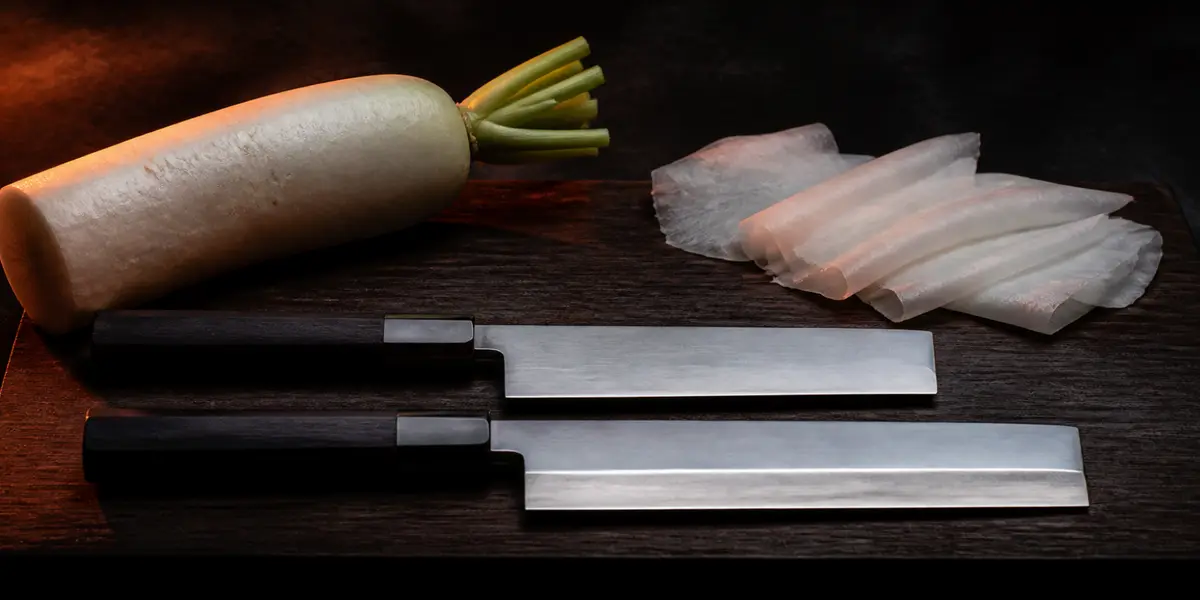
 See the bevel in a daikon
The outlines of these two knives can look alike, and the real difference is invisible until you look at the blade end-on. Tojiro explains that a double bevel goes into food straight. A single bevel behaves differently: Kai and Tojiro both say that on a right-handed blade the edge cuts slightly to the left, so the slice comes away cleanly and fine chopping goes faster. Choose a blade below, change the thickness of the cut and of the blade, and push it down.
Double bevel, 6 mm slice: the blade goes straight down and pushes both sides a little. A slice this thin simply bends out of the way.
A thin edge is not the same as an easy knife. Knifewear warns that a right-handed single bevel wants to pull left when you cut straight down, and that it takes practice to control. It also says to keep the usuba away from very hard vegetables such as kabocha, because the thin, hard edge can dull or chip. The crack in the figure belongs to the blade-thickness slider, not to either bevel. One knife-forum user describes carrots cracking on a chef’s knife after thinning it, but that is a single anecdote about a different knife. We found no controlled test of cracking on a nakiri or an usuba, so read that part of the figure as a picture of a wedge and nothing more.
 Nakiri vs usuba at a glance
| Nakiri | Usuba | |
|---|---|---|
| Japanese name | 菜切 (nakiri), “greens cutter” | 薄刃 (usuba), “thin blade” |
| Bevel | Double (ryōba) | Single (kataba); hollow back on the best knives (Wikipedia) |
| Hand | Either | Right- or left-handed blade |
| Typical length | About 165 mm (Tojiro); 16–18 cm (Wikipedia) | Often 210 mm for professionals (Ichimonji); 15–24 cm (Wikipedia) |
| Weight | Lighter | A little heavier, with a thicker spine (Knifewear, Wikipedia) |
| Shapes | Square | Edo-style (rounded tip per Ichimonji, square per Wikipedia) or kamagata (pointed) |
| Who it is sold to | Home cooks | Professional cooks and enthusiasts |
| Sharpening | Like most knives | The hardest of the three basic Japanese knives (Ichimonji) |
From Tojiro, Kai, Sakai Ichimonji Mitsuhide (“Ichimonji”, an Osaka knife shop), Knifewear and Wikipedia. Lengths are what these sources publish; individual knives vary.
Flat, square and double-bevel. Kai lists chopping, peeling, chamfering (rounding cut edges) and hollowing (digging out with the heel).
Single-bevel and thin at the edge, for fine cuts and katsuramuki (Ichimonji).

The bevel must stay flat and the edge straight, so it needs the most sharpening skill of the basic three.
Edo-style and kamagata: the two usuba outlines
An usuba is not one shape. Ichimonji divides it by region: the kamagata (鎌型, “sickle-shaped”) is mainly used in Kansai, and the Edo-style (江戸型) mainly in Kanto. The kamagata’s edge runs straight from heel to tip under a curved spine, so the point can do fine work. The Edo-style is rectangular; Ichimonji describes its tip as rounded, while Wikipedia calls it square. Ichimonji says that tip feels reassuring and that the wide blade is handy for carrying vegetables to the pot, but it does not suit decorative work. Wikipedia adds that Sakai, in Osaka, favors the kamagata’s “sheep’s foot” point.
One double-bevel home knife and two single-bevel professional outlines. Choose one to see its bevel and what the makers say about it.
Nakiri 菜切
- Bevel
- Double (Kai, Wikipedia)
- Outline
- Square, with a straight, flat edge (Tojiro)
- Length
- About 165 mm (Tojiro); 16–18 cm (Wikipedia)
- Uses
- Chopping, peeling, chamfering, hollowing with the heel (Kai)
Edo-style usuba 江戸型薄刃
- Bevel
- Single (Ichimonji)
- Region
- Mainly Kanto (Ichimonji)
- Outline
- Rectangular. Ichimonji says the tip is rounded, which feels reassuring but does not suit fine work; Wikipedia calls it square
- Length
- Professionals often use about 210 mm (Ichimonji)
Kamagata usuba 鎌型薄刃
- Bevel
- Single (Ichimonji)
- Region
- Mainly Kansai, which includes Sakai and Osaka (Ichimonji, Kai)
- Outline
- Edge straight from heel to tip; curved spine; the point can do fine work (Ichimonji)
- Length
- Professionals often use about 210 mm (Ichimonji)
- Heel: peeling, hollowing
- Middle: katsuramuki, chamfering, chopping
- Tip: decorative cuts, shaving
 Katsuramuki: why cooks reach for an usuba
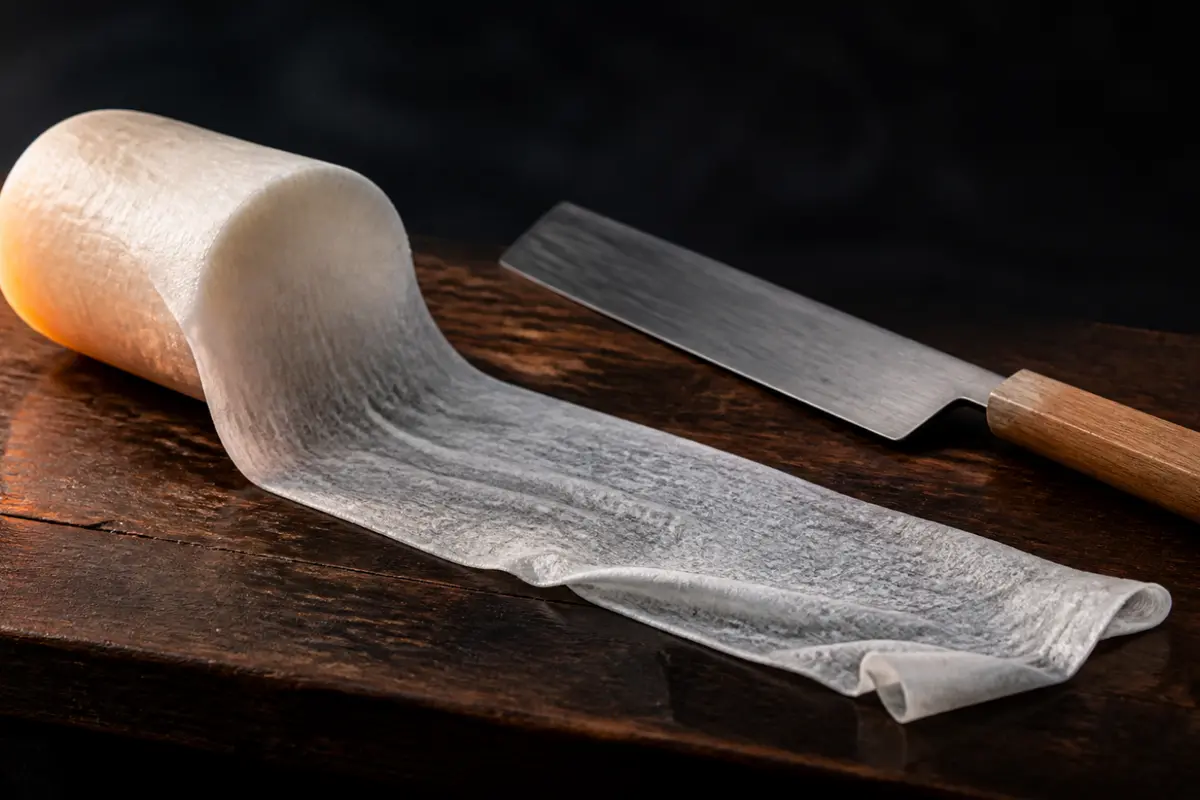
Katsuramuki means peeling a section of daikon into one continuous sheet while turning it against the blade. Ichimonji calls it a basic of Japanese cooking and the job the usuba is used for. Kai says the middle of a kamagata usuba does this work. Tojiro’s explanation of why the bevel matters is practical: for peeling vegetables and fruit, a single bevel is easier to control than a double bevel, so it suits thin peeling. Switch the figure above to Katsuramuki to see why a flat back helps.
Length matters here too. Ichimonji says professional cooks commonly use 210 mm and prefer 225 mm or more for chopping large vegetables, while some choose a shorter 180–195 mm for katsuramuki and peeling.
 “Usuba” does not always mean single bevel
Listings do not use these names consistently. Kai’s guide has a knife it calls usuba (nakiri) (薄刃(菜切)包丁), described as a thin, double-bevel vegetable knife, with a separate entry for the single-bevel kamagata usuba. Wikipedia, by contrast, treats the usuba as single-bevel and the nakiri as double-bevel, and so do Ichimonji and Knifewear. The two knives on this page are the common English meaning, but a listing that just says “usuba” may be either. Four things to check:
- 1Find the bevel
両刃 means double, 片刃 means single.
- 2
 Find the hand
A single bevel should state right or left. See below.
- 3Find the outline
鎌型 is kamagata; 江戸型 is Edo-style.
- 4
 Find the steel
Ichimonji sells both carbon and stainless usuba; see the steel chart.
More words like these are in the guide to reading knife kanji.
Usuba for left-handed cooks
A nakiri needs no thought here: it works the same in either hand. A single bevel does not. Tojiro says that with the edge on the wrong side for your hand the knife becomes unusable. It also explains why stamped left-handed knives are hard to make: they would need a new grinding pattern, while hand-forged knives can be made to order. Left-handed usuba do exist: Knifewear says usuba come in both versions. On its Misono listings, Korin says left-handed blades are special-ordered from Japan and can cost up to 50% more. Some shops list left-handed usuba in stock; Seisuke Knife had a 180 mm Sakai Takayuki when we checked. The general idea is covered in single-bevel vs double-bevel.
What sharpening an usuba asks of you
Ichimonji says the usuba needs the most sharpening skill of the three basic Japanese knives, because both the flat of the bevel and the line of the edge must stay straight. Knifewear agrees that you do not sharpen it like a double-bevel knife and that it takes more work on the stones. Our reading of that: since the whole bevel rests on the stone, a stone that has worn hollow matters more here. A nakiri is sharpened like most kitchen knives. Before you buy, look at the sharpening angle calculator, the whetstone grit chart and how to flatten a whetstone.
Nakiri or usuba: how to choose
You chop a lot of vegetables at home, share knives with others or are left-handed. Knifewear lists it as suitable for everyone.
You want to learn katsuramuki and fine Japanese cuts, and you are ready to sharpen a single bevel.
You already have a santoku or gyuto that you like and you do not cook many vegetables. Both of these are vegetable knives, so neither replaces an all-purpose knife.
Comparing other shapes? Santoku vs nakiri and gyuto vs nakiri cover the nakiri against all-purpose knives. For the other classic single-bevel knife, see sujihiki vs yanagiba. If you plan to buy in Japan or order from there, read the buying guide. All shapes are on the Japanese knife types page.
Frequently asked questions
- What is the difference between a nakiri and an usuba?
- The bevel. A nakiri is ground on both sides, so it goes straight into food and works in either hand. An usuba is ground on one side, with a thin edge and a flat or hollow back; it cuts very thin, releases slices well and is made for right or left hand. Wikipedia describes the nakiri as a home knife and the usuba as a professional one.
- What is an usuba knife used for?
- Ichimonji says it is used for vegetables in Japanese cooking: cutting, fine chopping and katsuramuki, the technique of peeling a daikon into one long thin sheet. Kai adds that on a kamagata usuba the tip does decorative cuts, the middle does katsuramuki, chamfering and chopping, and the heel does peeling and hollowing.
- Do left-handed cooks need a special usuba?
- Yes. Tojiro says a single-bevel knife used in the opposite hand becomes unusable, and that hand-forged knives can be made to order for left-handers while mass-produced stamped blades are very hard to reverse. On its Misono listings, Korin says left-handed blades are special-ordered from Japan and can cost up to 50% more, but some shops list left-handed usuba in stock. A nakiri works in either hand.
- Is an usuba a good first Japanese knife?
- Usually not. Tojiro recommends a double-bevel knife as the first one for home cooking, Ichimonji rates the usuba as the hardest of the basic three to sharpen, and Knifewear lists it for enthusiasts and professional chefs. If you mainly want to chop vegetables, a nakiri is simpler.
Sources
- Sakai Ichimonji Mitsuhide: usuba knives (kamagata and Edo types, regions, sizes, sharpening difficulty)
- Kai: choosing a Japanese-style knife (thin double-bevel “usuba (nakiri)”, kamagata usuba, nakiri, single-bevel release)
- Tojiro: edge direction and handedness (single and double bevel, peeling control, left-handed orders)
- Tojiro: the nakiri (straight edge, square blade)
- Tojiro: Classic series line-up (nakiri 165 mm F-502)
- Wikipedia: Japanese kitchen knife (usuba 15–24 cm, Edo and kamagata types; nakiri 16–18 cm)
- Wikipedia: Nakiri bōchō (home nakiri, professional usuba, weight)
- Knifewear: nakiri vs usuba (pull to the left, hard vegetables, sharpening, who each suits)
- Korin: a Misono honesuki listing (left-handed blades special-ordered, up to 50% more, in its Use section)
- Seisuke Knife: a left-handed Sakai Takayuki usuba, 180 mm, listed in stock when checked
- Kitchen Knife Forum: a user’s report of carrots cracking on a chef’s knife after thinning (anecdote, not a test)
Checked 2026-11-04. We have not tested these knives ourselves, and we found no controlled test comparing how the two bevels cut. The figures are illustrations built from how makers and shops describe the knives.