Knife shapes · sources checked 2026-11-02Santoku vs nakiri
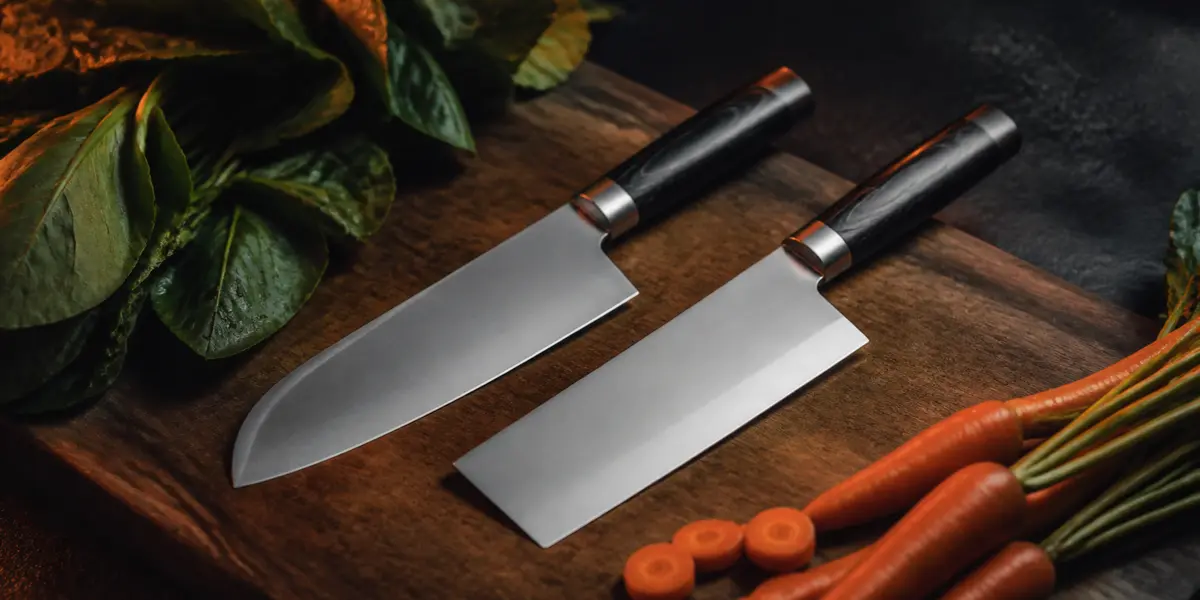
Short answer: both are double-bevel Japanese home knives of almost the same size — Tojiro sells its santoku at 170 mm and its nakiri at 165 mm, and both are about 295 mm overall. The difference is the front of the blade. A santoku has a rounded point and an edge that curves up near the tip, so it handles meat, fish and vegetables. A nakiri is square, with a straight, flat edge and no point, so the whole edge meets the board and vegetables are cut all the way through. Tojiro recommends the nakiri as a second knife, not a replacement for a santoku.
The quickest way to see the difference is to chop. Below, eight scallions sit under one blade. Choose a knife and drop it straight down — the way Tojiro says both knives are basically used — then try pushing forward.
✓ cut through to the board! orange = still joined at the bottom
In this drawing, Santoku 170 mm, straight down: 6 of 8 scallions cut through to the board; 2 under the curved front stay joined at the bottom.
 At a glance
| Santoku | Nakiri | |
|---|---|---|
| Japanese name | 三徳 (santoku) | 菜切 (nakiri) |
| What the name means | “Three uses” — meat, fish and vegetables (Kai) | “Greens cutter” — a vegetable knife |
| Typical length | 165–180 mm (Kai, Tojiro); Wikipedia gives 16–20 cm | About 165 mm (Tojiro); Wikipedia gives 16–18 cm |
| Edge | Flat at the heel, curving up near the tip | Straight and flat (hira-ba) end to end |
| Tip | A rounded point where the spine curves down to meet the edge | Square — no point |
| Blade outline (Tojiro) | Triangular | Rectangular |
| Main use (Tojiro) | All-purpose | Mostly vegetables |
| Bevel | Double | Double (Kai); the single-bevel cousin is the usuba |
From Tojiro’s nakiri and santoku guides (including its own santoku-vs-nakiri table), Kai’s selection pages and Wikipedia. Lengths are what makers publish; individual knives vary.
Tojiro Classic: santoku 170 mm, nakiri 165 mm — both about 295 mm overall.

Santoku: a rounded point and a gentle curve. Nakiri: square and flat.

Santoku: meat, fish and vegetables. Nakiri: vegetables first.
Santoku vs nakiri for vegetables
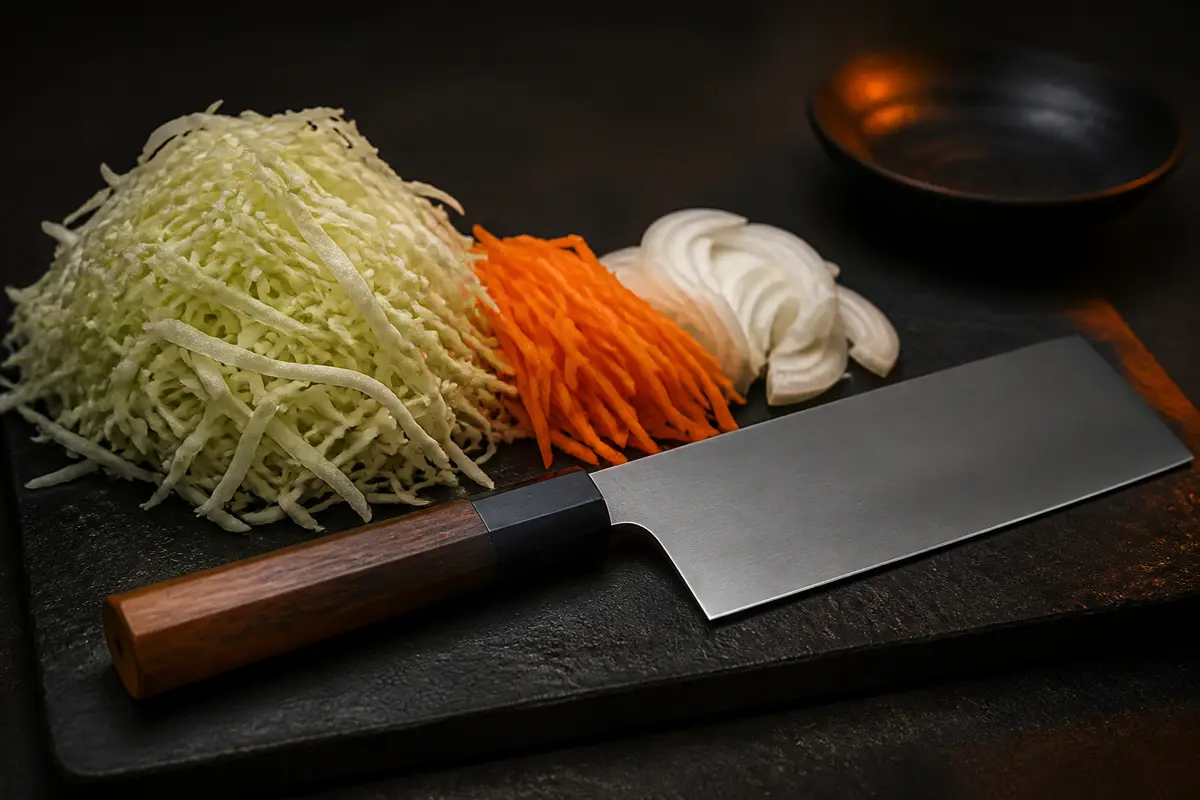
Both knives are made for the cuts that Japanese home cooking uses most: fine shreds (sengiri) and thin cross-cuts such as sliced scallions (koguchi-giri). Tojiro names exactly these as nakiri jobs. Its explanation is simple: the edge is straight and flat (hira-ba), the blade is square, and the basic stroke is a rhythmic chop straight down onto the board (“ton-ton”) rather than sawing back and forth. Because the whole edge meets the board, nothing is left joined at the bottom. The wide, fairly heavy blade lets the knife’s weight do the cutting, and it doubles as a scraper to carry the pile to the pan.
The santoku was built to do more than vegetables, but it is not far behind. Kai says that for shredding and small vegetables a santoku beats a gyuto, that its straight heel section suits big vegetables such as kabocha and cabbage — and even peeling daikon into a thin sheet — and that the heel corner (ago) is handy for digging out potato eyes. Tojiro adds that its long section parallel to the board means few slices are left joined. What it has that the nakiri lacks is the point.
Pick a job below to see which part of each blade does the work, and what each maker says about it.
Shred cabbage
Santoku ✓ Kai says the santoku beats a gyuto for shredding and for small vegetables. (Kai: what is a santoku)
Nakiri ✓ Tojiro names shredding (sengiri) as a nakiri job: the flat edge cuts each stroke right through. (Tojiro: the nakiri)
Slice scallions
Santoku ~ Tojiro: the long section of edge parallel to the board leaves few slices joined — but the curved front still lifts off the board. (Tojiro: gyuto and santoku)
Nakiri ✓ Tojiro lists thin cross-cuts (koguchi-giri) for the nakiri; the whole edge meets the board. (Tojiro: the nakiri)
Score with the tip
Santoku ✓ Kai: the pointed tip is ideal for making cuts into meat and vegetables. Tojiro adds trimming sinew and preparing fish. (Kai: what is a santoku)
Nakiri ✕ No point: Tojiro describes the nakiri tip as square, not pointed. (Tojiro: the nakiri)
Dig out potato eyes
Santoku ✓ Kai: the heel corner (ago) is handy for removing potato eyes. (Kai: what is a santoku)
Nakiri ✓ Kai lists hollowing out with the heel corner among nakiri uses, with chopping, peeling and chamfering. (Kai: Japanese-style knives)
Kabocha and big cabbage
Santoku ✓ Kai: the straight heel section suits large vegetables such as kabocha and cabbage, and peeling daikon (katsuramuki). (Kai: what is a santoku)
Nakiri ~ Tojiro: the wide, fairly heavy blade lets the knife’s weight do the cutting, not your arm. (Tojiro: the nakiri)
Carry to the pan
Santoku ~ Also wide and stable (Tojiro), but makers do not single it out for scooping. (Tojiro: gyuto and santoku)
Nakiri ✓ Tojiro: the wide blade doubles as a scraper to carry chopped food. (Tojiro: the nakiri)
Skin-on chicken thigh
Santoku ✓ Kai and Tojiro both list meat among the santoku’s jobs. (Kai: what is a santoku)
Nakiri ✓ Tojiro: the straight edge gives the skin nowhere to slip, so it cuts cleanly. Not for bones or frozen food. (Tojiro: the nakiri)
 Why they look alike: the santoku grew out of the nakiri
The two knives share a family tree. Kai says the santoku appeared around the 1940s by combining features of the Japanese nakiri and deba with the Western gyuto, and explains the name as “three uses”. Tojiro tells the same story in two steps: first a “bunka type” that fused the old nakiri with the gyuto that arrived from the West in the Meiji era, and then, after further changes, the santoku.
You can see the inheritance in the outline. The santoku keeps the nakiri’s tall blade and long, flat heel section, and borrows a point from the gyuto by curving the spine down to meet the edge — the down-turned, “sheep’s foot” tip that Wikipedia describes. That point is what lets it trim meat and prepare fish; the curve that forms it is also why the front few centimetres lift off the board in the chop test above.
The nakiri is not Japan’s only vegetable knife. The professional version is the usuba, which Wikipedia describes as similar in profile to the nakiri but single-bevel — and that changes how it cuts and how it is sharpened (see single-bevel vs double-bevel knives). Shop names are not consistent: Kai’s guide also lists a thin, double-bevel “usuba (nakiri)” for vegetables, so check the bevel in the listing.
 Santoku vs bunka, chef’s knife and kiritsuke
- Santoku vs bunka. Outside Japan, a bunka is the santoku-sized knife whose spine is cut at a slant to a sharp point. Some Japanese dictionaries treat bunka and santoku as two names for the same knife; others separate them by that angled tip. The details are in gyuto vs santoku vs bunka.
- Santoku vs chef’s knife. The gyuto is the Japanese chef’s knife: Kai starts it at 180 mm, and Tojiro says its curved edge allows pushing, pulling and swinging cuts as well as the santoku’s up-and-down chop. If you are coming from a German chef’s knife, see Japanese vs German knives.
- Nakiri vs chef’s knife. The same square-versus-pointed trade-off, with a longer gap in length — compared in gyuto vs nakiri.
- Santoku or nakiri vs kiritsuke. A kiritsuke has a long, nearly flat edge and an angled tip; the traditional version is single-bevel. See gyuto vs kiritsuke.
 Santoku or nakiri: how to choose
- 1Only one knife? Take the santoku.
It covers meat, fish and vegetables; the nakiri cannot do tip work.
- 2Already have one? Add a nakiri.
Tojiro recommends it as the second knife that makes vegetable prep easier.
- 3Lots of shredding? Nakiri.
The flat edge cuts every slice through on a straight chop.
- 4Need a point? Santoku or bunka.
For scoring, trimming sinew and preparing fish.
Size is rarely the deciding factor: the two are within a few millimetres of each other. The true-size tool in the knife size and handle guide has no santoku or nakiri, but its 180 mm gyuto is close to their length, so you can use it to check the space on your board. Then choose the steel in the Japanese knife steel chart, and if you are ordering from Japan, read the buying guide and check the import duty calculator.
Building a small set? The usual next knives are a slicer for fish and roasts — compare the sujihiki, yanagiba and takohiki — and a small knife for work in the hand: petty vs paring knife. All nine shapes are on the Japanese knife types page.
Looking at the single-bevel vegetable knife as well? See nakiri vs usuba.
Frequently asked questions
- Is a nakiri better than a santoku for vegetables?
- For straight up-and-down chopping, yes. Tojiro explains that the nakiri’s straight, flat edge meets the board along its whole length, so every slice is cut through. A santoku is close — Tojiro says its long section parallel to the board leaves few slices joined — and it also handles meat and fish.
- Can a santoku replace a nakiri?
- For most home cooks, yes, because the santoku covers meat, fish and vegetables. Tojiro’s advice runs the other way: it recommends the nakiri as a second knife that makes vegetable prep easier, not as a replacement for the santoku.
- Is a nakiri single-bevel?
- No. Kai lists the nakiri as a double-bevel knife, so it works in either hand. Names vary between shops — Kai even lists a thin, double-bevel “usuba (nakiri)” for vegetables — but the professional usuba is single-bevel, and Wikipedia describes it as similar in profile to the nakiri. Check the bevel in the listing.
- What size are santoku and nakiri knives?
- Tojiro gives 165–180 mm for the santoku and about 165 mm for the nakiri. Its Classic line sells them at 170 mm and 165 mm, and both are about 295 mm overall, so they take up the same space on a board.
Sources
- Tojiro: the nakiri (flat edge, square tip, straight-down chopping, scraper, chicken skin, santoku comparison table)
- Tojiro: gyuto and santoku (santoku born from the bunka type; long section parallel to the board; uses of the tip)
- Tojiro: knife sizes by type (santoku 165–180 mm, nakiri about 165 mm)
- Tojiro: Classic series line-up (santoku 170 mm F-503 and nakiri 165 mm F-502, both about 295 mm overall)
- Kai: what is a santoku knife (nakiri, deba and gyuto as ancestors; tip, heel and ago uses; vs gyuto for shredding)
- Kai: choosing a Western-style knife (santoku 165–180 mm)
- Kai: choosing a Japanese-style knife (nakiri: double-bevel; chopping, peeling, chamfering, hollowing with the heel)
- Wikipedia: Japanese kitchen knife (santoku 16–20 cm with a down-turned tip; nakiri 16–18 cm; usuba)
- Kotobank: 文化包丁 (bunka — same knife as the santoku, or a different tip)
Checked 2026-11-02. We have not tested these knives ourselves, and we found no controlled test comparing how the two shapes cut. The chop test and outlines are illustrations built from how Tojiro and Kai describe the shapes; blade heights and curves vary by maker.